Did a Rhinoceros Win an Election in Brazil?
In October 1959, a five-year-old black rhinoceros named Cacareco received 100,000 votes in a São Paulo city council election — ten times more than the nearest human candidate. The election board nullified her ballots. The Portuguese language kept her name forever.

TL;DR: Yes. On October 4, 1959, a five-year-old female black rhinoceros named Cacareco received approximately 100,000 write-in votes in the São Paulo city council election — 15% of all ballots cast and roughly ten times more than the nearest human candidate. She beat all 540 competitors. Election officials nullified her votes and ordered a new election. "Voto Cacareco" remains the standard Portuguese term for a protest vote.
Published: June 2026 · Written by the Hidden World research team · hiddenworld.io
A rhinoceros did win an election in Brazil. On October 4, 1959, a five-year-old female black rhinoceros named Cacareco — Portuguese for "rubbish" — received 100,000 votes in the São Paulo municipal council election, outpolling every one of the 540 human candidates running for 45 seats. The nearest human competitor received roughly 10,000. The story is not a joke. It was reported as news by TIME Magazine, The New York Times, and Life Magazine within days of the vote.
Who Was Cacareco?
Cacareco was born in 1954 at the Jardim Zoológico do Rio de Janeiro, the daughter of two rhinoceroses named Britador and Terezinha. In 1958, she was loaned to the newly opened São Paulo Zoo. She was a local attraction — well-known among families who visited the zoo on weekends. Her name, Cacareco, translates loosely to "rubbish" or "garbage" in Portuguese (Wikipedia: Cacareco).
The director of the Rio de Janeiro zoo was not sentimental about his asset. He described her publicly as "an ugly beast, very stupid" and added: "You could put her brain in a Brazil nut." She weighed roughly two tonnes. She ate 70 pounds of vegetables a day. She had no political opinions.
Why Did 100,000 People Vote for a Rhinoceros in the 1959 São Paulo Election?
São Paulo in 1959 was a city of three million people governed by politicians who had stopped governing. Sewers overflowed into streets. Trash collection had collapsed. Food prices were climbing under the weight of national inflation driven by President Juscelino Kubitschek's ambitious but fiscally reckless industrialisation programme. In June 1959 — four months before the election — Kubitschek broke off negotiations with the International Monetary Fund rather than accept austerity measures, a move that deepened the crisis (Wikipedia: Presidency of Juscelino Kubitschek). Supplies of meat and beans were dwindling. The cost of living was rising faster than wages.
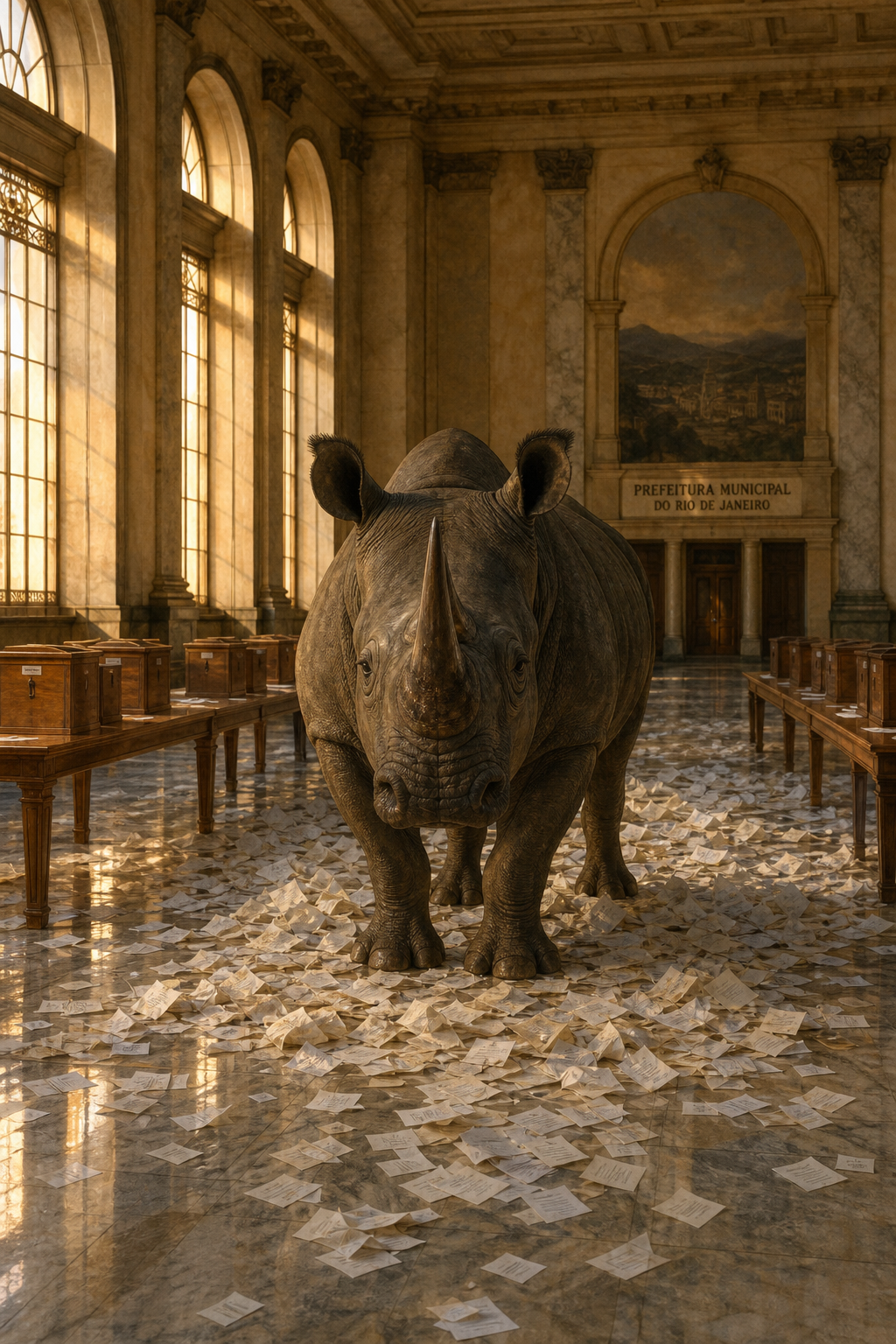
Against this backdrop, 540 candidates entered the October 4 city council race for 45 seats. The ballot system required voters to manually write a candidate's name on a paper slip and seal it in an envelope. There was no pre-printed ballot. Any name was valid as a write-in.
A journalist named Itaboraí Martins, frustrated with the quality of the candidates, proposed Cacareco's name as a protest entry. A group of university students ran with the idea. They printed 200,000 paper ballots bearing her name and distributed them to the already-angry electorate. The ballots were not stuffed. Each of the 100,000 votes for Cacareco was cast individually, voluntarily, by a registered voter walking into a polling station and placing her name in the envelope.
The Results: 100,000 Votes and the Scale of the Defeat
When the Tribunal Regional Eleitoral de São Paulo completed the count, Cacareco's total stood at approximately 100,000 — roughly 15% of all ballots cast. This was not only the highest individual vote count in the election. It was, as The New York Times reported, one of the highest totals for a local candidate in Brazilian electoral history to that date.
The closest human candidate received approximately 10,000 votes. Cacareco beat the runner-up by a factor of ten. She outperformed not just individual candidates but entire political parties.
TIME Magazine ran the story on October 19, 1959, under the headline "BRAZIL: The Rhino Vote." The magazine noted that Cacareco's "only graft is 70 lbs. of vegetables each day" — a pointed contrast with the politicians she had beaten (TIME: The Rhino Vote).
Cacareco was not the only form of protest that day. Thousands of voters in the same election filled their ballot envelopes with black beans instead of paper — a gesture of total rejection, choosing a staple food that was becoming unaffordable over any name on the list.
What Happened After the Vote
Election officials nullified all 100,000 ballots on the grounds that Cacareco was not eligible for office. A new election was held the following week. The city council was seated with human members. The structural problems — the sewers, the inflation, the food shortages — continued.
The intellectual class took the vote seriously. A Brazilian sociologist described the result as "a phenomenon of the greatest sociological importance" and warned that it signalled Brazil was "on the threshold of revolt." This was not hyperbole. Five years later, in 1964, a military coup overthrew the civilian government. The inflation that had helped drive 100,000 voters to write a rhinoceros's name on their ballots rose from 30.5% in 1960 to 92.1% in 1964.
Cacareco herself returned to the zoo. She died in 1962 of a liver ailment. She was eight years old.
The Legacy: Voto Cacareco and the Rhinoceros Party of Canada
The phrase "Voto Cacareco" entered Brazilian Portuguese almost immediately after the election and has never left. It remains the standard colloquial term for a protest vote — a ballot cast not for a candidate but against the entire system. It has been invoked in Brazilian political commentary for more than six decades, including during the 1988 São Paulo mayoral race and in analyses of high null-vote rates in subsequent elections.
The legacy crossed continents. In 1963, four years after Cacareco's victory, a Montreal physician and writer named Jacques Ferron founded the Rhinoceros Party of Canada. The party declared itself the "spiritual descendants" of Cacareco and appointed a black rhinoceros named Cornelius the First, from the Granby Zoo east of Montreal, as its nominal leader. The party's stated philosophy was "a promise to keep none of our promises."
The Rhinoceros Party was not marginal. In the 1984 Canadian federal election, it received the fourth-largest number of votes nationally, ahead of several established minor parties. Candidates occasionally placed second in individual ridings. The party operated from 1963 to 1993, was refounded in 2007, and remains a registered political party with Elections Canada. In the 2019 federal election, the Rhinoceros Party ran a candidate named Maxime Bernier in the same riding as People's Party leader Maxime Bernier. Neither was elected.
Cacareco was not the first animal to receive votes in a Brazilian election. In 1954, a goat named Smelly was elected to the city council of Jaboatão in Pernambuco. But Cacareco remains the most successful animal candidate in recorded electoral history, by a margin that no human protest vote has matched in scale or in cultural persistence. [Link to related article on protest votes in history]
Key Facts
- Cacareco, a female black rhinoceros born in 1954 at the Rio de Janeiro zoo, received approximately 100,000 write-in votes in the October 4, 1959, São Paulo city council election.
- Her vote total represented 15% of all ballots cast and was roughly ten times higher than the nearest human candidate's approximately 10,000 votes.
- 540 candidates competed for 45 city council seats in the election.
- "Cacareco" means "rubbish" in Portuguese; students printed 200,000 paper ballots with her name, but each vote was cast individually by a registered voter.
- Election officials nullified all votes for Cacareco and held a new election the following week.
- "Voto Cacareco" remains the standard Brazilian Portuguese term for a protest vote, still in active use more than sixty years later.
People Also Ask
Did a rhinoceros really win an election in Brazil?
Yes. Cacareco, a five-year-old female black rhinoceros, received approximately 100,000 votes in the São Paulo city council election on October 4, 1959. She received more votes than any of the 540 human candidates. Election officials nullified her ballots on grounds of ineligibility and ordered a new vote.
How many votes did Cacareco the rhinoceros get?
Cacareco received approximately 100,000 votes, which represented about 15% of all ballots cast. The nearest human candidate received roughly 10,000 votes. Her total was one of the highest recorded for a local candidate in Brazilian history at the time, as reported by The New York Times.
What does "Voto Cacareco" mean?
"Voto Cacareco" is the Brazilian Portuguese term for a protest vote — a ballot cast to reject all available candidates rather than to support one. The phrase has been in continuous use since 1959 and appears in political analysis, journalism, and everyday speech across Brazil.
What was the Rhinoceros Party of Canada?
The Rhinoceros Party was a Canadian satirical political party founded in 1963 by Jacques Ferron. It declared itself the spiritual descendant of Cacareco and appointed a real rhinoceros, Cornelius the First from the Granby Zoo, as its leader. The party promised to keep none of its promises. In the 1984 federal election, it received the fourth-highest national vote total. It was refounded in 2007 and remains registered with Elections Canada.
Why did people in São Paulo vote for a rhinoceros?
São Paulo in 1959 was experiencing food shortages, overflowing sewers, uncollected rubbish, and rising prices driven by national inflation under President Kubitschek's industrialisation programme. Voters faced 540 candidates for 45 council seats and viewed none of them as capable of addressing these problems. Students and a journalist organised the write-in campaign as a deliberate act of protest.
Was Cacareco the first animal elected to office?
No. In 1954, a goat named Smelly was elected to the city council of Jaboatão in the Brazilian state of Pernambuco. However, Cacareco remains the most successful animal candidate in recorded electoral history by total vote count, margin of victory, and lasting cultural impact.
What happened to Cacareco after the election?
Cacareco returned to the zoo. She died in 1962 of a liver ailment at approximately eight years of age. Her name lives on in the Portuguese language as a synonym for democratic protest, and her candidacy inspired the founding of a political party in Canada that operated for thirty years.
One detail is easy to miss. The election used paper ballots — each voter wrote a name by hand, sealed it in an envelope, and submitted it. There was no pre-printed list. No checkbox. Every one of the 100,000 people who voted for Cacareco had to stop, pick up a pen, and deliberately write the name of a rhinoceros. They did not stumble into it. They chose it, one envelope at a time, in a country where the sewers did not work and the price of beans was rising and 540 politicians had asked for their trust. A hundred thousand people answered with the name of a five-year-old animal whose own name meant rubbish.
Hidden World uncovers the buried, forgotten, and misunderstood stories underneath the world's great cities. More stories at hiddenworld.io.