What Was the Soviet Dog Head Experiment of 1925?
In 1925, a Soviet physician severed a dog's head and kept it alive with two pumps and a glass jar. The machine he built became the blueprint for open-heart surgery.

Published: June 2026 · Written by the Hidden World research team · hiddenworld.io
TL;DR: In 1925, Soviet physician Sergei Bryukhonenko severed a dog's head and connected it to a machine he called the autojektor — two pumps and a glass reservoir that replaced the heart and lungs. The head remained responsive for up to 100 minutes, reacting to stimuli including sound, touch, and taste. The autojektor became the direct precursor to the heart-lung bypass machines used in every open-heart surgery since.
This article contains affiliate links. If you purchase through these links, Hidden World earns a small commission at no extra cost to you. This supports our research and keeps the guides free.
In a Moscow laboratory in 1925, a Soviet physician named Sergei Bryukhonenko placed a severed dog's head on a table and connected it to a machine. The machine — two diaphragm pumps, a glass reservoir, and a length of rubber tubing — replaced the dog's heart and lungs. The head blinked. It flinched when a hammer struck the table beside it. When citric acid was dabbed on its nose, it licked it off. The Soviet dog head experiment was not a thought experiment or a rumour. It was documented, demonstrated before a congress of pathologists, and eventually filmed by the state.
Bryukhonenko and the Autojektor: How It Worked
Sergei Sergeevich Bryukhonenko was born on 30 April 1890. He trained as a physician, and his early career was shaped by the mass casualties of the First World War — soldiers bleeding to death from injuries that could, in theory, be repaired if the heart and lungs could be temporarily replaced by a machine. By 1922, he had begun developing a device to do exactly that.
The machine he built was called the autojektor. It consisted of two linear diaphragm pumps — one venous, one arterial — connected to a glass reservoir where blood was oxygenated by contact with air. Thick rubber tubing carried the blood from the reservoir to the subject and back. The device was crude by any modern standard. It looked, as one American student newspaper later described it, like "a queer-looking affair made of glass and rubber tubing."
But it worked. The autojektor could circulate oxygenated blood through a body — or part of a body — without a functioning heart or lungs. Bryukhonenko's first experiments isolated individual organs: a dog's heart beating outside its body, a lung inflating and deflating in a tray. These were proofs of concept. The next step was the one that made history.
The Severed Head: What the Experiment Actually Showed
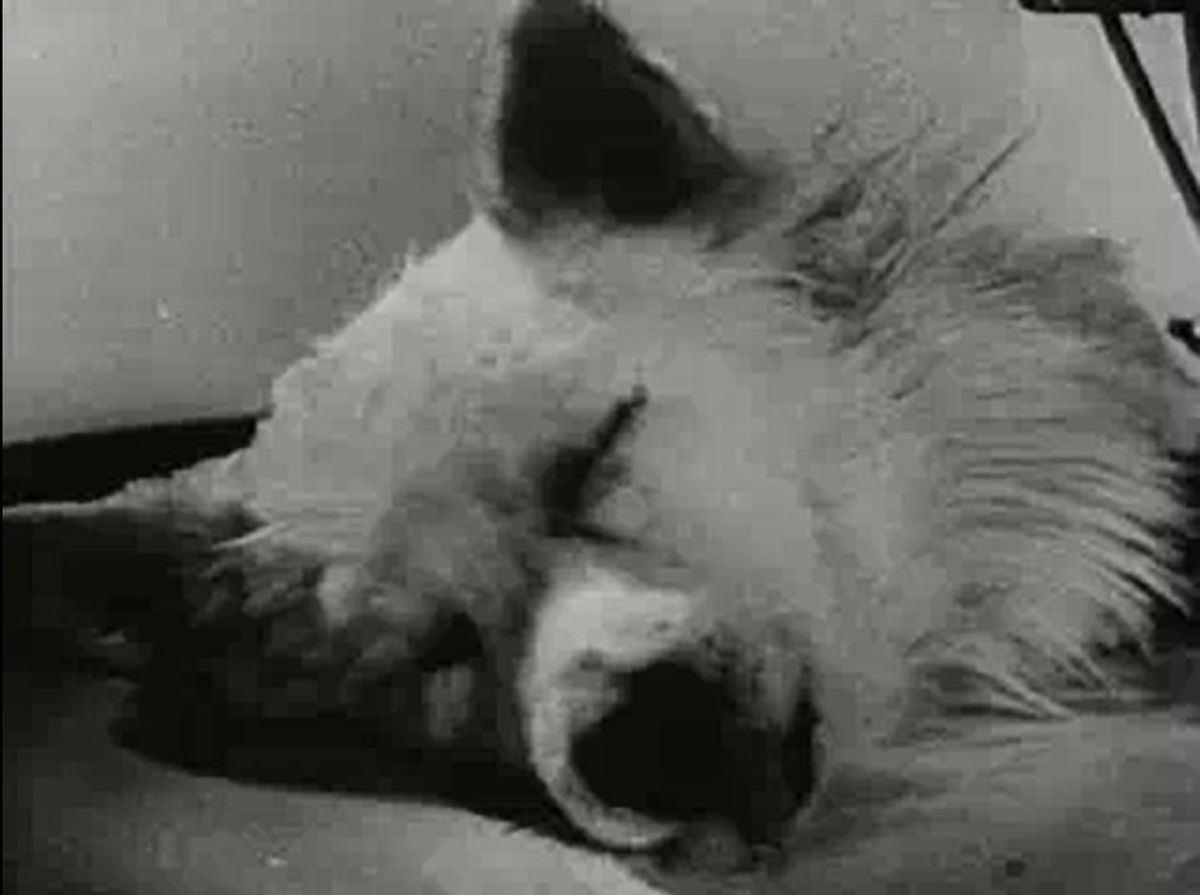
In 1925, Bryukhonenko demonstrated the autojektor to the Second Congress of Russian Pathologists in Moscow. He severed a dog's head — a white, medium-sized animal, likely a Spitz-type breed — and connected it directly to the machine. The head lay on its side on a flat table, the severed neck exposed, rubber tubes inserted into the vessels to carry oxygenated blood from the autojektor into the brain.
The head responded to external stimuli. When a hammer was struck against the table surface, the ears twitched. When a bright light was shone into the eyes, the pupils contracted. When citric acid was applied to the nose, the tongue extended and the head licked its own nose. According to Bryukhonenko's report to the congress, the head remained responsive for approximately 100 minutes before blood clots accumulated and the experiment ended (Loskutov, 2017).
The reactions were not voluntary in any meaningful sense. They were reflexive — the brainstem responding to sensory input as long as oxygenated blood continued to reach it. But the visual reality of a severed head blinking and licking its nose on a laboratory table was enough to make the experiment one of the most disturbing scientific demonstrations of the twentieth century.
The 1940 Film: Soviet Propaganda and the Manhattan Screening
In 1940, the Soviet state studio Techfilm in Moscow produced a 19-minute documentary titled Experiments in the Revival of Organisms (Russian: Опыты по оживлению организма). The film was directed by David Yashin, with the script written by Bryukhonenko himself. It depicted, in sequence: a dog's heart beating outside its body, a lung breathing in a tray, the autojektor in operation, a severed dog's head responding to stimuli, and a dog drained of all blood, left dead for ten minutes, then revived.
The film was originally produced for Soviet audiences. In 1943, an English-language version was created with an introduction by J.B.S. Haldane, a renowned British geneticist who stated on camera that he had personally witnessed these procedures at an all-Russian physiological congress. This version was screened for approximately one thousand American scientists at a Congress of American-Soviet Friendship in Manhattan.
The reaction was immediate. Time magazine reported: vague rumours had been reaching the United States that Russian scientists had revived corpses. MIT's student paper described the autojektor as a device that kept a severed dog's head alive for three and a half hours. The playwright George Bernard Shaw, on hearing of the experiments, remarked that he was greatly tempted to have his own head cut off so that he could continue to dictate plays.
The Film Lied
The documentary claimed the revived dogs lived for years afterward, producing healthy offspring. The laboratory records told a different story. According to the institute's own documentation, the severed heads survived for minutes — not the hours the film implied. The dogs that were drained of blood and revived suffered serious brain damage and typically survived only a few days, not years (Konstantinov, Annals of Thoracic Surgery, 2000).
The film's authenticity has been debated since its public release through the Prelinger Archives. Ken Smith, author of Mental Hygiene: Classroom Films 1945–1970, argued the film was a staged recreation, noting that the severed head sequence uses tight close-ups and frequent cuts that resist scientific scrutiny. Others have pointed out that the experiments themselves are well documented in peer-reviewed medical literature — the film may have exaggerated, but the underlying work was real.
The State Was Watching
Bryukhonenko's experiments did not happen in isolation. The Soviet state had a specific interest in resuscitation science. The Institute of Experimental Physiology and Therapy, where much of this work took place, was founded in 1936 by Vladimir Negovsky — a physician who would spend much of the Second World War leading frontline resuscitation teams, attempting to revive soldiers who were bleeding to death or had already bled out.
The political dimension mattered. Bryukhonenko's stated purpose was not to keep dog heads alive. It was to develop the capacity to revive fallen Soviet soldiers — a goal that aligned directly with state priorities. Following his experiments with canines, Bryukhonenko was granted permission to continue autojektor experiments with human cadavers. In 1934, working with the surgeon Sergei Spasokukotsky, he attempted to revive a man who had died by suicide just three hours earlier. The machine drew cold dead blood from the corpse and returned it warm and oxygenated. A heartbeat appeared. The man's eyelids opened. Two minutes later it was over. The attempt failed. (Frank Swain's How to Make a Zombie: The Real Life (and Death) Science of Reanimation and Mind Control covers this episode and the broader Soviet resuscitation programme in detail.)
The human experiments produced no encouraging results. Bryukhonenko lost favour with Soviet leadership. He led the Institute of Experimental Surgical Devices and Instruments from 1951 to 1958, a quieter posting. He died on 20 April 1960 of rectal cancer, largely forgotten.
The Legacy: From Dog Head to Open-Heart Surgery
Five years after his death, in 1965, Bryukhonenko was posthumously awarded the Lenin Prize — the Soviet Union's highest recognition for contributions to science. The citation acknowledged his work in advancing artificial blood circulation and laying the groundwork for cardiac surgery.
The connection is direct. Bryukhonenko's colleague Nikolay Terebinsky used the autojektor concept to perform open-heart experiments on dogs from 1929 to 1940. In 1957, Professor Alexander Vishnevsky performed the first Soviet open-heart operation — a procedure that would not have been possible without a machine to take over the heart and lungs while the surgeon worked. That machine descended, in a straight line of development, from the autojektor.
The modern equivalent is the extracorporeal membrane oxygenation (ECMO) machine, used in intensive care units worldwide. The principle is identical to what Bryukhonenko demonstrated in 1925: pump blood out, oxygenate it, pump it back in. The engineering has advanced. The concept has not changed.
Where the Machine Is Now
A later version of the autojektor, adapted for use on human patients, is reportedly on display at the Museum of Cardiovascular Surgery within the Bakulev Scientific Center of Cardiovascular Surgery in Moscow. The Bakulev Centre, founded in 1956, is one of the largest cardiovascular surgery facilities in Europe, located at Varshavskoye Shosse 1A, Moscow. It is a working hospital, not a tourist destination. Whether the museum is accessible to casual visitors is unconfirmed.
The museum page on the Bakulev website has been defunct since 2008. No publicly available photograph of the autojektor in its display case has surfaced. The machine that started with a dog's head on a table in 1925 — the machine that led to open-heart surgery, ECMO, and every cardiac bypass procedure performed since — sits in a museum in Moscow that almost nobody knows exists.
The 1940 film is easier to find. It is in the public domain and available in full on the Internet Archive, where it has been since the Prelinger Archives released it. The footage is exactly as disturbing as the descriptions suggest.
Key Facts
- Sergei Bryukhonenko developed the autojektor between 1922 and 1924 — one of the first heart-lung machines ever built.
- In 1925, the autojektor kept a severed dog's head responsive for approximately 100 minutes at the Second Congress of Russian Pathologists in Moscow.
- The 1940 Soviet documentary Experiments in the Revival of Organisms depicted the experiments but exaggerated the results — lab records show the dogs survived days, not years.
- The film was screened for approximately 1,000 American scientists in Manhattan in 1943.
- Bryukhonenko was posthumously awarded the Lenin Prize in 1965 for advancing artificial blood circulation.
- The autojektor's direct descendants include the heart-lung bypass machine and the modern ECMO system used in hospitals worldwide.
People Also Ask
Did Soviet scientists really keep a dog's head alive?
Yes. Sergei Bryukhonenko demonstrated a severed dog's head responding to stimuli — including sound, light, and taste — while connected to his autojektor machine at a congress of pathologists in Moscow in 1925. The experiments are documented in peer-reviewed medical literature. The duration and degree of responsiveness remain debated, with the 1940 film likely exaggerating the results.
What was the autojektor?
The autojektor was an early heart-lung machine designed by Bryukhonenko between 1922 and 1924. It consisted of two diaphragm pumps (venous and arterial) and a glass reservoir for oxygenating blood. It could circulate oxygenated blood through an organ, a severed head, or an entire body without a functioning heart or lungs.
Is the 1940 dog head experiment film real?
The film Experiments in the Revival of Organisms (1940) is a real Soviet documentary, now in the public domain via the Prelinger Archives. The underlying experiments are well documented. However, the film likely exaggerates several claims — particularly the duration the severed heads survived and the long-term recovery of revived dogs. Some commentators believe the film is a restaging rather than direct documentation.
How did the dog head experiment lead to open-heart surgery?
Bryukhonenko's autojektor proved that a machine could temporarily replace the heart and lungs. His colleague Nikolay Terebinsky used the concept for open-heart experiments on dogs from 1929 to 1940. In 1957, Professor Vishnevsky performed the first Soviet open-heart operation using a bypass machine descended from the autojektor. The modern ECMO machine operates on the same principle.
Where is the autojektor now?
A later version of the autojektor adapted for human patients is reportedly on display at the Museum of Cardiovascular Surgery at the Bakulev Scientific Center of Cardiovascular Surgery in Moscow (Varshavskoye Shosse 1A). The museum's website page has been defunct since 2008, and no public photograph of the display has surfaced online.
Where can I watch the 1940 Soviet dog experiment film?
The full 19-minute film is available on the Internet Archive at archive.org/details/Experime1940. It is in the public domain. The film contains graphic depictions of animal experiments.
Who was Sergei Bryukhonenko?
Sergei Sergeevich Bryukhonenko (1890–1960) was a Soviet physician and biomedical scientist. He developed the autojektor, one of the first heart-lung machines, and demonstrated its use in keeping severed dog heads alive and reviving clinically dead dogs. He was posthumously awarded the Lenin Prize in 1965. His work laid the groundwork for cardiac surgery in the Soviet Union.
The machine that kept a dog's head alive on a table in Moscow in 1925 is the reason a surgeon can stop a human heart today, repair it, and start it again. Bryukhonenko died without recognition. The Lenin Prize came five years after his death. The autojektor sits in a museum in Moscow that has no working website. The film is on the Internet Archive, available to anyone, and still as unsettling as it was when a thousand American scientists watched it in a darkened Manhattan auditorium in 1943.
Hidden World covers stories like this one — the buried, forgotten, and misunderstood histories underneath the world's great cities. More at hiddenworld.io.
What to Read Next
- [Link to related article on Vladimir Demikhov's two-headed dog experiments, 1954]
- [Link to related article on the history of heart-lung machines and cardiac bypass surgery]
- Alan Bellows, Alien Hand Syndrome: And Other Too-Weird-Not-to-Be-True Stories — includes a chapter on the Soviet dog experiments and the autojektor