Who Was Zarafa? The Giraffe Who Walked 550 Miles Across France and Made 'Giraffe Yellow' a Fashion Color in 1827
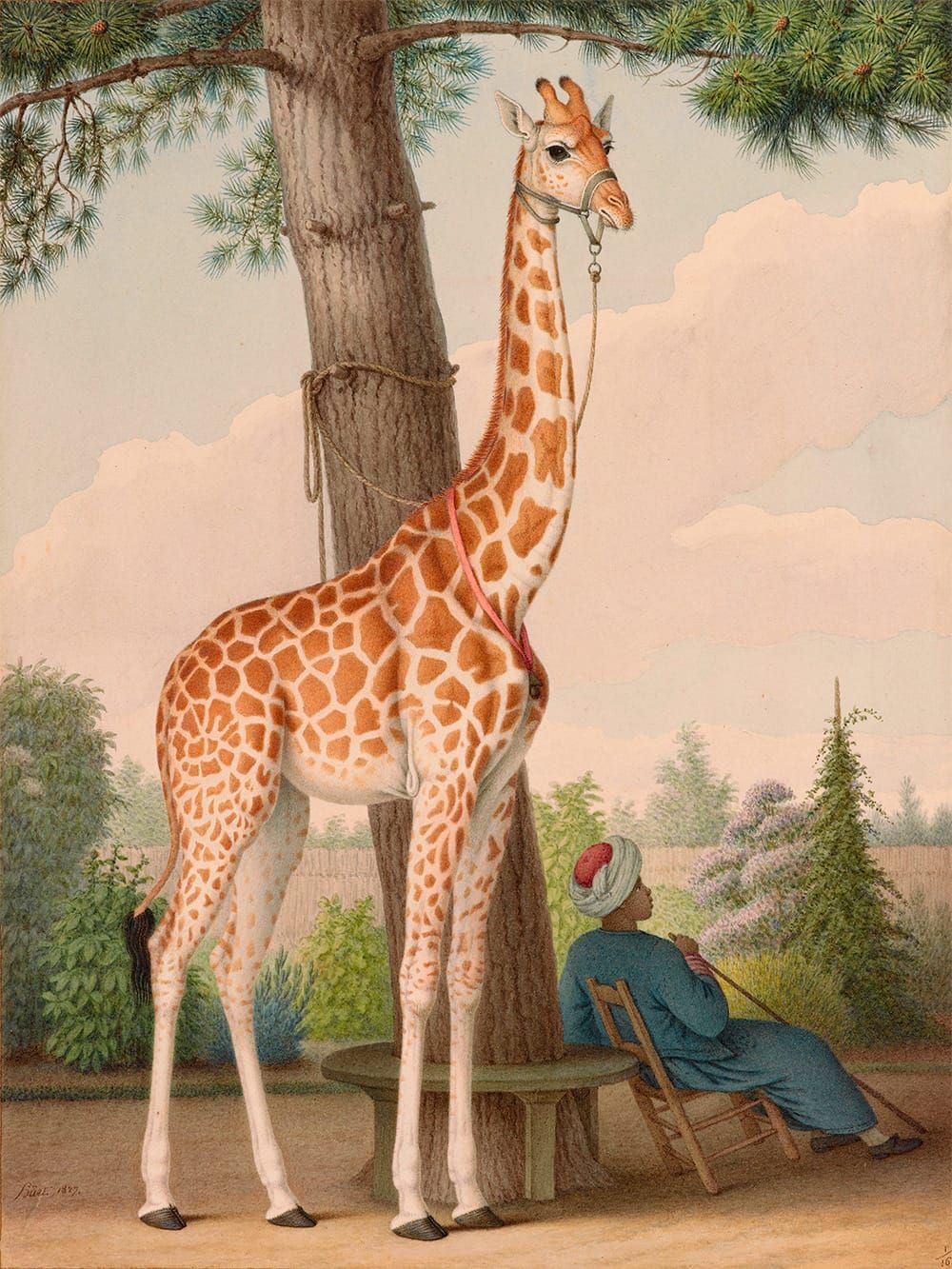
In 1827, a young Nubian giraffe walked 550 miles from Marseille to Paris as a diplomatic gift to King Charles X. She was the first living giraffe France had seen in over three centuries — and she triggered a full-blown fashion craze.

This article contains affiliate links. If you buy through them, Hidden World earns a small commission at no extra cost to you.
TL;DR: In 1827, a young Nubian giraffe captured in Sudan walked 550 miles from Marseille to Paris as a diplomatic gift from Egypt’s viceroy to King Charles X. She was the first living giraffe France had seen in over three centuries. She drew 600,000 visitors in a single summer and triggered a full-blown fashion craze — giraffe-print fabrics, towering hairstyles, and a color Parisians called ‘giraffe yellow.’
| Fact | Detail |
|---|---|
| Name | Zarafa (name given posthumously; Arabic for ‘gracious’) |
| Species | Female Nubian giraffe, captured as a calf in Sudan, c. 1824 |
| Gift from | Muhammad Ali Pasha, Ottoman Viceroy of Egypt, to King Charles X of France |
| Arrived Marseille | October 31, 1826 |
| Walk to Paris | 550 miles, 41 days, departing May 20, 1827 |
| Arrived Paris | June 30, 1827; presented to king at Saint-Cloud, July 9, 1827 |
| Visitors (first summer) | 600,000 at the Jardin des Plantes |
| Died | January 12, 1845 — 18 years in Paris |
| Remains today | Natural History Museum, La Rochelle, France |
How did a baby giraffe end up walking across France?
The story begins not in France but in the grasslands of Sudan, around 1824, where a young giraffe was captured and placed in the care of Muhammad Ali Pasha, the Ottoman Viceroy of Egypt. His reasons were entirely political. He was commanding Turkish forces fighting the Greeks in their war of independence and hoped a lavish gift might persuade King Charles X of France to look the other way. The giraffe was his offering.
The journey she undertook before setting foot in France was extraordinary on its own terms. Transported overland by camel and then down the Nile to Alexandria, she crossed the Mediterranean on a specially adapted ship — the deck above the cargo hold was cut open so she could extend her neck through it and breathe fresh air. Three cows traveled with her, providing roughly twenty-five litres of milk a day throughout the voyage. After thirty-two days at sea, she arrived at the port of Marseille on October 31, 1826.
Getting her to Paris presented a separate problem. The options were another sea voyage around the Iberian Peninsula and up the Atlantic coast, or a river route up the Rhône — both considered too dangerous for an animal of her size and fragility. The decision was made: she would walk. All 550 miles of it. The naturalist Étienne Geoffroy Saint-Hilaire, then fifty-five years old and one of France’s leading scientists, was dispatched to accompany her. He ordered a two-piece yellow coat and leather shoes made to protect her from the spring weather.
What happened along the 41-day walk from Marseille to Paris?
She set out on May 20, 1827. The procession was a slow, deliberate march through the heart of France — passing through Aix-en-Provence, Avignon, Orange, Montélimar, and Vienne, covering between twenty and twenty-five kilometres a day. Word traveled ahead of her. By the time she reached each town, crowds were already waiting.
In Lyon, on June 6, 1827, thirty thousand people gathered to watch her pass through the city. Saint-Hilaire later wrote that he had to fight the crowds who rushed toward the animal at every stop. She was escorted by mounted guards and three footmen holding her by leather leashes, with her milk cows walking ahead of her to coax her forward. A waxed raincoat embossed with the royal fleur-de-lis kept her dry when the weather turned.
She arrived at the Jardin des Plantes in Paris on June 30, 1827, and was formally presented to King Charles X at the Château de Saint-Cloud nine days later, on July 9. The king hand-fed her rose petals. For anyone who wants to follow in her footsteps and stand in the very garden where she lived, a guided tour of the Jardin des Plantes and the National Museum of Natural History brings the history of this place into sharp focus.
Why was France so astonished by a giraffe?
Because no living person in France had ever seen one. The last giraffe on European soil had been the Medici giraffe, sent to Lorenzo de’ Medici in Florence in 1486 — more than three centuries before Zarafa’s arrival. In the intervening years, giraffes had become the stuff of illustration and rumor. Many people genuinely believed the animal was a kind of myth, grouped alongside unicorns and dragons as creatures too strange to be real. When she finally arrived, she confirmed a legend — and Paris was entirely unprepared for the feeling.
Over 600,000 visitors came to the Jardin des Plantes in the summer of 1827 alone. Daily queues formed at the gates. Writers, scientists, painters, and royalty all made their way through. Honoré de Balzac wrote about her. Gustave Flaubert, then a young child living in Rouen, was taken to Paris specifically to see her. The press called her la Belle Africaine — the Beautiful African — and the name stuck.
How did Zarafa trigger a Parisian fashion craze?
Almost immediately. Within months of her arrival, what journalists called la mode à la girafe had taken hold across the city. The craze touched everything. Women styled their hair in towering, horn-like constructions known as coiffure à la girafe, propped high on the head to mimic the animal’s ossicones. Men adopted elongated hats and ties in her honor. Spotted fabrics flooded the textile markets. Giraffe-themed wallpaper covered the walls of Parisian apartments. Porcelain, fans, soaps, combs, and accessories all bore her likeness.
And then there was the color. The Petit Courrier des Dames reported in September 1827 that a yellowish hue — what might previously have been called café au lait — was now being called simply ‘giraffe.’ The Journal des Dames named it ‘belly of giraffe.’ Either way, the shade dominated belts, workbags, and dresses across the city for the better part of two years. A fashion trend born from a single animal walking through a gate.
The full sweep of this story — from Sudan to the Nile to the streets of Marseille and into the Parisian court — is told in remarkable detail by Michael Allin, who retraced the entire journey from Khartoum to Paris before writing his account of Zarafa’s life, which reads as much like a political thriller as a natural history.
What was the real political reason behind the gift?
Muhammad Ali Pasha was a calculating ruler who understood the power of spectacle. In the late 1820s, he was commanding Ottoman forces suppressing the Greek war of independence — a cause that had significant sympathy across Europe, including in France. By sending giraffes simultaneously to Charles X of France, George IV of Britain, and Francis II of Austria, he was buying goodwill and distraction at the highest levels. France, dazzled by the animal, largely stayed out of the conflict — though not entirely and not for long. The giraffe outlasted Muhammad Ali’s political calculations.
She also outlasted the king himself. Charles X was overthrown in the July Revolution of 1830, just three years after Zarafa arrived in Paris. By then, the fashion craze had already faded. By 1830, la mode à la girafe was gone, and few visitors still came to the Jardin des Plantes to see her. She lived on, largely forgotten, for another fifteen years.
How long did Zarafa live in Paris, and what happened to her remains?
She died on January 12, 1845, having lived at the Jardin des Plantes for eighteen years. Her Sudanese handler, Atir, who had accompanied her from Africa, stayed with her until the end. She had grown to 4.3 metres tall during her years in Paris.
After her death, her stuffed skin entered a museum in Verdun, where she reportedly became a talisman for French soldiers during the First World War. In 1931, she was moved to the Natural History Museum in La Rochelle, in the Charente-Maritime, where she still stands today in a stairway section of the building — almost entirely intact, nearly two centuries after she arrived in Marseille. Her skeleton, which had been held separately in a museum in Normandy, was destroyed in a bombing raid on Caen during the Second World War.
The French language carries one small trace of her memory: the expression peigner la girafe — ‘to comb the giraffe’ — meaning to spend time on a long, pointless task. It is believed to have come from the caretaker’s daily work of grooming her coat during her years in captivity.
Can you visit the Jardin des Plantes today and connect it to Zarafa’s story?
Yes. The Jardin des Plantes, where Zarafa spent her eighteen years, still operates as a botanical garden and zoo in the 5th arrondissement of Paris, along the Seine. The Ménagerie — the zoo where she lived — is still there, making it one of the oldest continuously operating city zoos in the world. The Grand Gallery of Evolution at the adjacent National Museum of Natural History puts the story of animal life and diplomacy in striking context. For visitors who want more than a walk through the grounds, a private guided tour of the Museum of Natural History and Jardin des Plantes offers skip-the-line access and expert commentary on the history embedded in these buildings.
The garden is open daily and free to enter, though the Ménagerie is ticketed separately. Spring is considered the best time to visit, when the gardens are in full bloom — though Zarafa herself arrived in high summer, through streets packed with people who had been waiting for months.
If you want to go deeper into the full journey — from the Sudanese savanna to the streets of Paris — Michael Allin’s Zarafa: A Giraffe’s True Story, from Deep in Africa to the Heart of Paris has been published in eighteen languages and was selected for the French Reader’s Digest. It remains the definitive account of what was, by any measure, one of the stranger chapters in the history of European fashion.