When Was the Guillotine Last Used in France?
France beheaded its last prisoner on September 10, 1977, in a Marseille prison courtyard. The executioner was a printer. Most voters wanted to keep it.

TL;DR: France's last guillotine execution took place on September 10, 1977, at 4:40 AM in the courtyard of Baumettes Prison, Marseille. The condemned man was Hamida Djandoubi, aged 27. The executioner was Marcel Chevalier, a printer by trade. France abolished the death penalty on October 9, 1981, under Justice Minister Robert Badinter — against 63 percent public support for keeping it.
This article contains affiliate links. If you book through these links, Hidden World earns a small commission at no extra cost to you. This supports our research and keeps the guides free.
The guillotine was last used in France on September 10, 1977. Not in the 1790s. Not during the Terror. Four months after Star Wars premiered in American cinemas, a man was woken before dawn in a Marseille prison cell and walked to a machine designed in 1792. The gap between what most people assume about the guillotine — that it belongs to the French Revolution — and what is actually true is roughly two centuries wide.
The Machine That Outlasted Every Government That Used It
The guillotine became France's sole legal civilian execution method in 1791. The National Assembly adopted it on the recommendation of Dr Joseph-Ignace Guillotin, who argued it was more humane than the alternatives — hanging, the wheel, burning at the stake. The device was designed by surgeon Antoine Louis and built by German engineer Tobias Schmidt.
The first person executed by guillotine was Nicolas-Jacques Pelletier, on the Place de Grève in Paris, on April 25, 1792. The crowd, accustomed to the drawn-out spectacle of hanging, reportedly felt cheated by the speed of the blade.
The machine survived the Revolution. It survived Napoleon. It survived the Restoration, the Second Empire, the Franco-Prussian War, the First World War, the German Occupation, the Liberation, the Fourth Republic, the Fifth Republic, the Moon landing, and the invention of the personal computer. The mechanical principle never changed. A weighted angled blade dropped between two vertical runners. The head fell into a basket.
France used the same method of execution for 190 years. Daniel Arasse's The Guillotine and the Terror remains the most thorough study of how the machine sustained its hold on French political life across that span.
The Last Public Execution — and the Teenager in the Crowd
The last public guillotine execution in France took place on June 17, 1939, outside Prison Saint-Pierre in Versailles. The condemned man was Eugen Weidmann, a serial killer convicted of six murders.
The crowd that gathered was so unruly — jostling for position, shouting, dipping handkerchiefs in the blood pooling on the cobblestones — that President Albert Lebrun immediately banned all public executions. From that morning onward, the blade fell behind prison walls.
A 17-year-old in the crowd that morning was Christopher Lee, who would later become one of the most prolific horror actors in cinema history — Count Dracula, Saruman, Count Dooku. In interviews decades later, he said he heard the blade fall and the crowd surge. He said he turned his head.
After 1939, the guillotine continued its work in private. The public stopped seeing it. That did not mean it stopped.
Marcel Chevalier — The Printer
By the 1970s, France's chief executioner held the official title "Monsieur de Paris." The role had passed through families for generations, often from father to son or uncle to nephew. Marcel Chevalier inherited the position from his wife's uncle, André Obrecht, in 1976.
Chevalier's profession was printing. He ran a commercial print shop. His government retainer as executioner was 3,650 francs per month. He received an additional 6,000 francs per execution carried out.
He had assisted in roughly 40 executions before becoming chief. As chief, he would carry out exactly two. Both in 1977. Both in prison courtyards. Both before dawn.
Hamida Djandoubi — The Last Victim
Hamida Djandoubi was a Tunisian agricultural worker living in Marseille. He had lost part of his right leg below the knee in an industrial accident and wore a prosthetic. He was convicted of the kidnapping, torture, and murder of 21-year-old Élisabeth Bousquet, along with additional charges of assault and proxénétisme. He was sentenced to death.
On September 10, 1977, at approximately 4:40 AM, guards entered his cell at Baumettes Prison in Marseille. Djandoubi was required to strap on his prosthetic leg before being escorted to the courtyard. The execution was carried out by Marcel Chevalier.
Djandoubi was 27 years old. He was the last person executed by guillotine in France — and the last person beheaded by any Western nation.
The Decade-Long Fight to Abolish It
Robert Badinter was a French lawyer who had witnessed a client he believed to be wrongly convicted sent to the blade in 1972. The execution changed the course of his career. He spent the next decade campaigning against capital punishment in France.
When François Mitterrand won the presidency in May 1981, he appointed Badinter as Justice Minister. On September 17, 1981, Badinter addressed the National Assembly. He told the chamber that the time had come to end what he called stealthy executions at dawn under a black canopy.
The law abolishing the death penalty passed on October 9, 1981. At the time it was enacted, a poll by the French Institute of Public Opinion measured public support for keeping the guillotine at 63 percent. The Assembly voted to abolish it anyway.
Badinter went on to serve as President of the Constitutional Council. He died on February 9, 2024, at the age of 95. On October 9, 2025 — 44 years to the day after abolition — he was inducted into the Panthéon. His account of the campaign, L'Abolition, is the definitive record of how one lawyer dismantled a 190-year institution. An earlier companion volume, L'Exécution, describes the 1972 execution that set him on the path.
The Guillotine Behind Glass
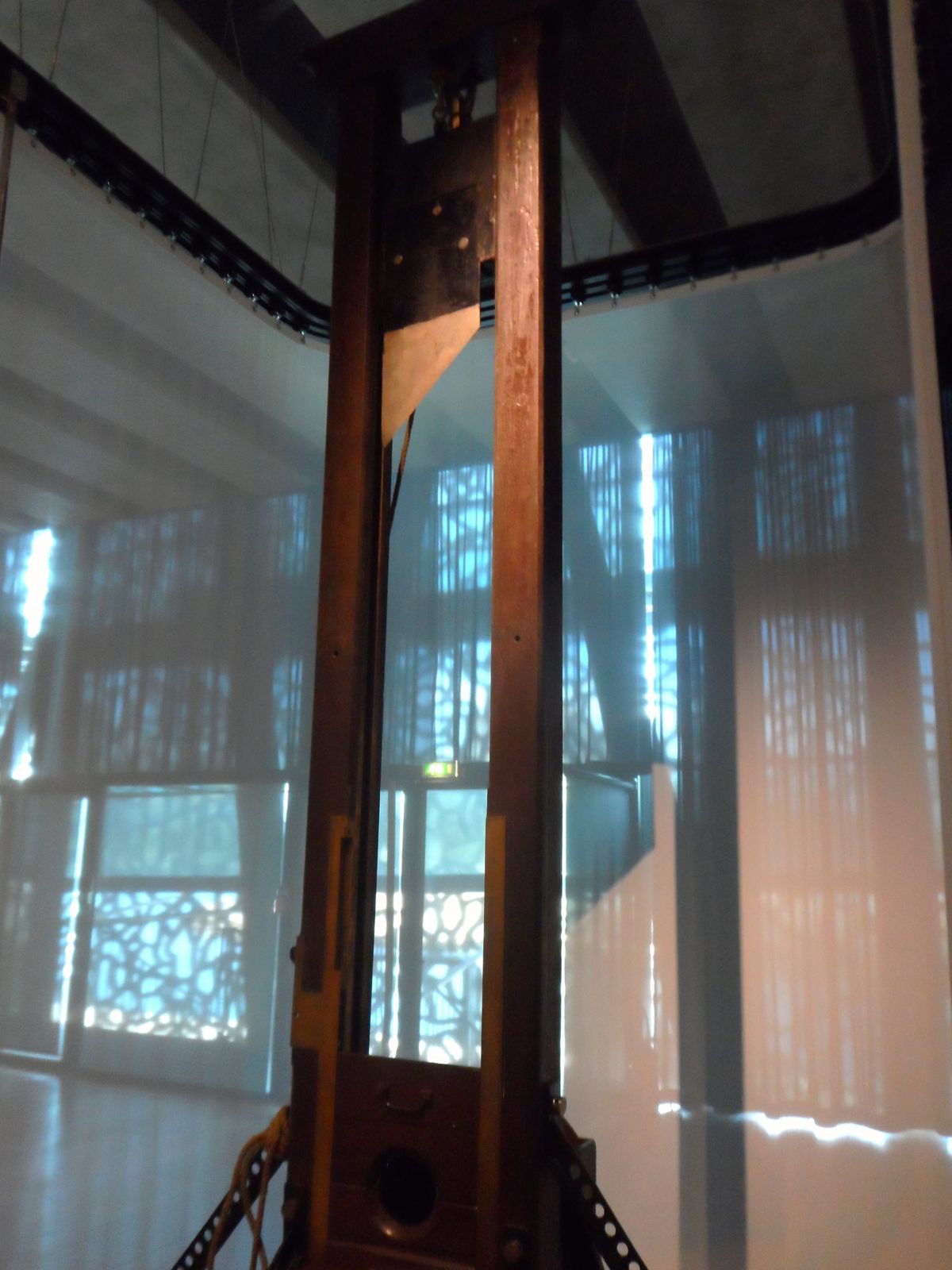
The guillotine that is now part of France's national museum collections was built in 1872 by Alphonse-Léon Berger, replacing an earlier model destroyed during the Paris Commune of 1870. It is made of dark oak and metal, stands nearly 15 feet tall, and weighs 1,763 pounds.
Badinter himself arranged for the guillotine to enter the national collections in 1982, one year after abolition. He imposed one condition: it could not be exhibited to the public before the year 2000. He wanted the political debate to cool before the object became heritage.
The guillotine went on public display at Mucem — the Museum of European and Mediterranean Civilisations — in Marseille in October 2025, as part of the permanent exhibition "Populaire? Les trésors des collections." It had been shown publicly only three times since 1981. Visitors walk through a section called "Movements of the People" and encounter the machine at the end.
Baumettes Prison, where the blade last fell, is five kilometres south of the museum where the guillotine now sits behind glass. The Marseille City Pass includes Mucem entry alongside public transport and other museums — the simplest way to cover the museum and the surrounding waterfront in a single day.
Key Facts
- France's last guillotine execution took place on September 10, 1977, at Baumettes Prison in Marseille.
- The condemned man was Hamida Djandoubi, aged 27, convicted of murder, torture, and kidnapping.
- The executioner was Marcel Chevalier, a printer by profession, who held the hereditary title "Monsieur de Paris."
- France abolished the death penalty on October 9, 1981, under Justice Minister Robert Badinter.
- At the time of abolition, 63 percent of the French public supported keeping the death penalty.
- A guillotine built in 1872 went on display at Mucem in Marseille in October 2025, donated by Badinter himself.
People Also Ask
Who was the last person executed by guillotine in France?
Hamida Djandoubi, a 27-year-old Tunisian agricultural worker convicted of the murder of Élisabeth Bousquet in Marseille. He was executed at 4:40 AM on September 10, 1977, at Baumettes Prison. He was also the last person beheaded by any Western nation.
Who was France's last executioner?
Marcel Chevalier, who held the title "Monsieur de Paris." He inherited the role from his wife's uncle, André Obrecht, in 1976. Chevalier's civilian profession was printing. He carried out two executions as chief — both in 1977 — before the office was dissolved following abolition in 1981.
When did France abolish the death penalty?
France abolished the death penalty on October 9, 1981. Justice Minister Robert Badinter presented the bill to the National Assembly on September 17, 1981. The law passed despite polls showing 63 percent of the public supported keeping capital punishment.
Was the guillotine used after the French Revolution?
Yes. The guillotine remained France's sole legal civilian execution method from 1791 to 1981 — a span of 190 years. It was used throughout the Napoleonic era, both World Wars, and into the late twentieth century. The last execution took place in 1977.
Where can I see a guillotine in France?
A guillotine is on display at Mucem (the Museum of European and Mediterranean Civilisations) in Marseille, as part of the "Populaire?" exhibition. It was built in 1872 and donated to the national collections by Robert Badinter in 1982. The Marseille City Pass includes Mucem entry. The Musée de la Préfecture de Police in Paris also holds a guillotine blade and scale model. Admission to both museums is free.
When was the last public guillotine execution in France?
June 17, 1939. Eugen Weidmann was beheaded outside Prison Saint-Pierre in Versailles. The crowd was so disorderly that President Albert Lebrun immediately banned all further public executions. From that point, all executions took place behind prison walls.
Was Robert Badinter in the Panthéon?
Robert Badinter was inducted into the Panthéon on October 9, 2025 — 44 years to the day after the law abolishing the death penalty passed. He died on February 9, 2024, at the age of 95.
The guillotine was designed as an instrument of mercy — faster, more certain, more equal than the noose or the pyre. It remained in service for nearly two centuries. The last time it was used, the man who operated it went back to his print shop the following week. The machine is now behind glass in a museum on the Mediterranean coast. Most visitors to Marseille walk past Baumettes Prison without knowing what happened there 48 years ago. The blade is five kilometres north, under gallery lighting, surrounded by schoolchildren on field trips.
The Hidden Paris guide covers twelve locations like this one — the full story is free at hiddenworld.io.
Published: June 2026 · Written by the Hidden World research team · hiddenworld.io