Why Is There a Mummified Arm Hanging in a Prague Church?

TL;DR: A blackened, mummified human forearm has hung from an iron chain inside Prague's Church of St. James the Greater (Kostel sv. Jakuba Většího) for approximately 400 years. The church's own inscription records that a thief reached for the jewels on the Madonna statue and was seized by the figure. When no one could free him, members of Prague's Guild of Butchers — who had guarded the church since the fifteenth century — amputated his forearm. It has never been taken down.
This article contains affiliate links. If you purchase through these links, Hidden World earns a small commission at no extra cost to you. This supports our research and keeps the guides free.
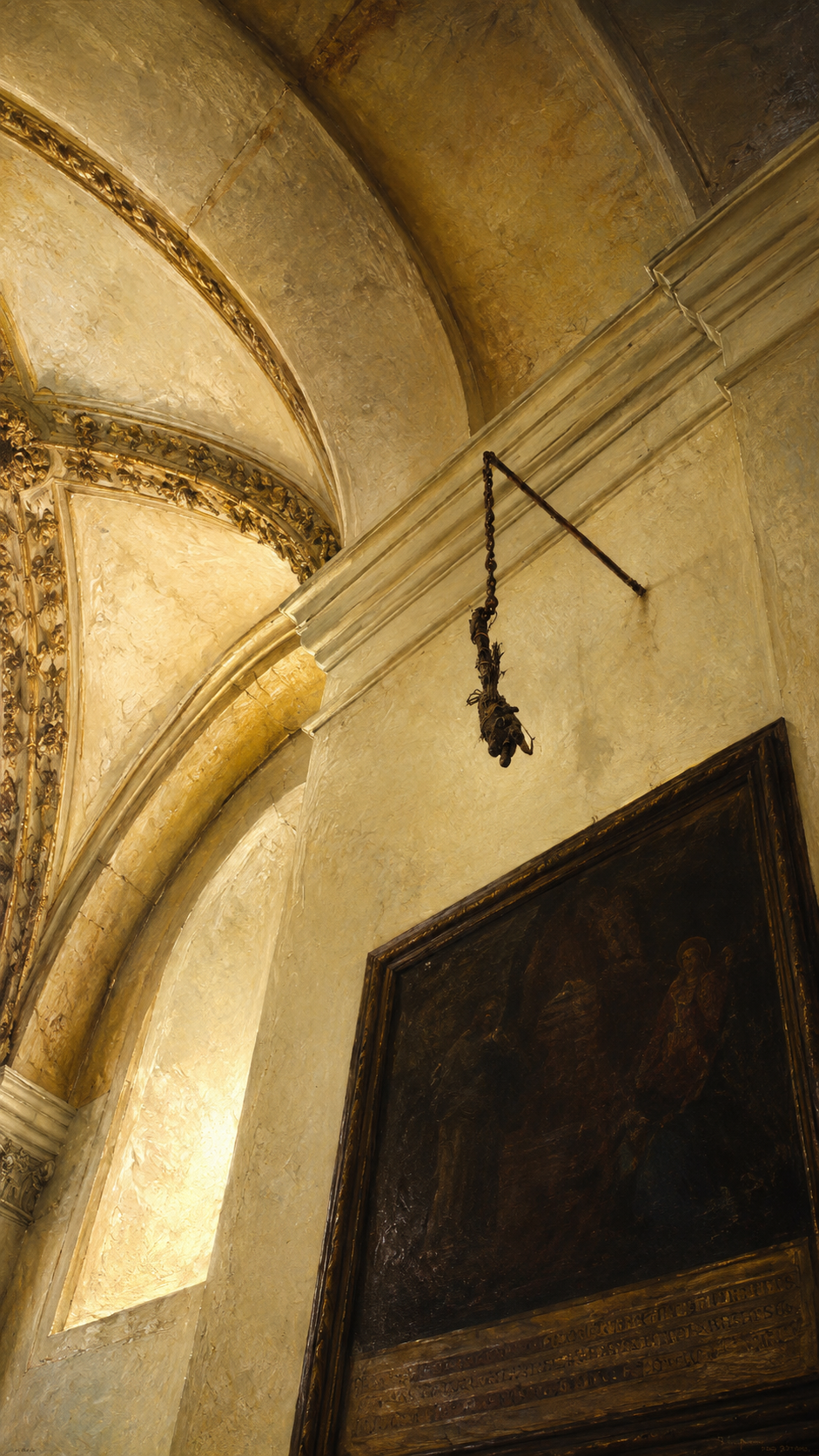
Inside the Church of St. James the Greater in Prague's Old Town, a mummified arm hangs from an iron chain near the entrance. It is blackened, shrunken to roughly half its original size, and suspended from an angled iron rod mounted high on the wall of the Gothic-ribbed entrance narthex. Most visitors walk directly beneath it without looking up. The church does not spotlight it. There is no announcement. There is a small sign, and there is the arm, and there are four hundred years of silence between them.
What the Church's Own Inscription Says About the Mummified Arm
The account is inscribed on a sign near the entrance — the church's own primary source. A thief crept into the church at night and reached for the jewels on the statue of the Virgin Mary at the high altar. The statue seized his arm and held him until morning. When the parishioners arrived, they could not free him. They amputated. The moment the limb was severed, the statue returned to its normal position.
The arm was thrust onto a meat hook and hung near the entrance as a warning. It has not been moved since.
The statue in question is the Madonna Pietatis — a fifteenth-century wooden Pietà that remains on the high altar of the church today, illuminated in blue light. It is one of Prague's most venerated religious objects. The thief would have walked the full length of the dark nave to reach it.
The Butchers Who Guarded the Church of St. James
The detail that separates this story from every other theft legend in Europe is the identity of the people who performed the amputation. The Church of St. James was protected by Prague's Guild of Butchers for over four hundred years.
During the Hussite Wars of the fifteenth century, when reformers sacked churches across Prague, the butchers defended the Minorite monastery attached to the church. In 1611, when the army of Passau invaded Prague, the butchers defended it again. These were tradesmen whose daily work involved the precise separation of joints and tissue. They had the tools. They had the skill. And when a thief could not be freed from a statue's grip, they were the people in the room best equipped to solve the problem.
The amputation was not improvised. It was performed by professionals. The distinction matters: the thief's arm was not removed as punishment. Every account — from the church's inscription to contemporary retellings — records that the parishioners tried to free him first. They failed. The butchers were called because no one else could solve the problem. The cut was a last resort, not a sentence.
For readers who want to go deeper into the legends behind Prague's churches and monuments, Alena Ježková's 77 Prague Legends covers this story and 76 others, all tied to locations that still exist and can be visited today.
A Church Built in the 1230s, Burned in 1689, Still Standing
The Church of St. James the Greater has stood on this site since the 1230s, founded as part of a Minorite monastery under King Wenceslas I of Bohemia. The original structure was Gothic. In 1689, agents believed to be working for Louis XIV of France set fire to Prague's Old Town during the Nine Years' War. The Church of St. James was hit worst of all — the vaulted ceiling collapsed and the Gothic interior was destroyed.
It was rebuilt in the Baroque style it wears today. The reconstruction added twenty-three altars, ceiling frescoes by František Voget painted in 1736, and an organ with 8,277 pipes — the largest in Prague and the second largest in the Czech Republic. Artists including Petr Brandl, Václav Vavřinec Reiner, and Jan Jiří Heinsch contributed paintings for the altars. The tomb of Count Jan Václav Vratislav of Mitrovice, Bohemian Chancellor to Holy Roman Emperor Joseph I, was designed by Johann Bernhard Fischer von Erlach and completed between 1714 and 1716. It is considered one of the most accomplished Baroque tombs in Bohemia.
The arm survived the fire. It predates the current interior. Everything around it was destroyed and rebuilt. The arm remained.
The Concerts That Play Beneath the Arm
The Church of St. James is one of Prague's most active concert venues. The International Organ Festival, founded in 1996 by principal organist Irena Chřibková, brings performers from across Europe, the United States, and Japan for Thursday evening recitals. Free organ concerts are held on Sunday mornings. On any concert evening, several hundred people sit in the nave facing the gilded high altar and the massive organ above the entrance.
The arm hangs behind them, near the door they came through. It is small and dark and easy to miss in the dim light of the entrance narthex. The church does not announce it. There is no spotlight. Most concertgoers sit beneath it for an hour and leave without knowing it was there.
Where to Find the Arm — and the Statue
The arm is immediately to the right of the entrance, above head height, in the narrow Gothic-ribbed narthex. A large dark framed painting hangs on the wall directly below it. A crucifix is mounted on the opposite wall. The arm hangs from an iron chain attached to an angled iron rod — it is small, blackened, and looks like a piece of dried cured meat. If no one tells a visitor to look up, most will miss it.
The Madonna Pietatis — the statue that, according to the inscription, seized the thief — is at the opposite end of the church on the high altar, lit in blue. The distance between the arm and the statue is the full length of the Baroque nave. Both have occupied the same building for centuries. The arm at the door. The Madonna at the altar. Neither has moved.
For a broader survey of the dark relics and buried histories across Prague's Old Town, Magdalena Wagnerová's Old Prague Legends covers twenty-nine sites that can still be visited today, including several within walking distance of St. James.
Key Facts
- A mummified human forearm has hung from an iron chain inside the Church of St. James the Greater in Prague for approximately 400 years.
- The church's own inscription says a thief reached for the jewels on the Madonna Pietatis and was seized by the statue until morning.
- Prague's Guild of Butchers, who had defended the church since the Hussite Wars of the fifteenth century, performed the amputation when no one could free the thief.
- The original Gothic church, founded in the 1230s under King Wenceslas I, was destroyed by fire in 1689 during the Nine Years' War — the arm predates the current Baroque interior.
- The church organ has 8,277 pipes, the largest in Prague, and the building hosts regular concerts including the International Organ Festival founded in 1996.
- The church is located at Malá Štupartská 6, Prague 1, with free entry and daily opening hours.
People Also Ask
Is the mummified arm in the Prague church real?
The arm is a real mummified human forearm. It hangs from an iron chain in the entrance narthex of the Church of St. James the Greater (Kostel sv. Jakuba Většího) in Prague's Old Town. It has been there for approximately four hundred years. The church displays it openly and references its origin on a sign near the entrance.
Why was the thief's arm cut off in the Church of St. James?
According to the church's own inscription, the thief was seized by the Madonna statue on the high altar and could not be freed. The parishioners attempted to release him but failed. Members of Prague's Guild of Butchers, who had guarded the church for centuries, amputated his forearm as the only remaining solution. The amputation was not a punishment — it was performed because no other option worked.
Where exactly is the mummified arm inside the church?
The arm is immediately to the right of the main entrance, above head height, in the narrow Gothic-ribbed narthex. It hangs from an iron chain attached to an angled iron rod mounted on the wall. A large dark painting hangs below it. It is small, blackened, and easy to miss without prior knowledge of its location.
Can you visit the Church of St. James the Greater in Prague?
The church is open daily with free entry. It is located at Malá Štupartská 6, Prague 1, in the Old Town. The nearest metro station is Náměstí Republiky. Photography policies may vary — some visitors have reported restrictions on indoor photography.
What is the Madonna Pietatis in the Church of St. James?
The Madonna Pietatis is a fifteenth-century wooden Pietà displayed on the high altar of the Church of St. James, illuminated in blue light. It is one of Prague's most venerated religious statues. The church's legend attributes the capture of the thief to this statue, claiming it seized his arm and would not release him until morning.
What happened to the Church of St. James in the 1689 fire?
In 1689, agents believed to be working for Louis XIV of France set fire to Prague's Old Town during the Nine Years' War. The Church of St. James suffered the worst damage — the vaulted ceiling collapsed and the Gothic interior was destroyed. The church was rebuilt in the Baroque style visible today, with twenty-three altars, ceiling frescoes, and an organ with 8,277 pipes.
Are there concerts at the Church of St. James in Prague?
The Church of St. James is one of Prague's most active concert venues. The International Organ Festival has been held there since 1996. Free organ concerts are offered on Sunday mornings. The church's organ, with 8,277 pipes, is the largest in Prague and the second largest in the Czech Republic.
The arm is still there. The concerts continue. Several hundred people sit beneath it on any given evening and listen to Bach and Handel played on an organ with 8,277 pipes. The church does not mention the arm. There is no programme note. There is only the music, and the silence of the narthex behind them, and a small dark object on a chain that most people never see.
The Hidden Prague guide covers twelve locations like this one — places where the real story is the one Prague stopped telling. The full guide is available at hiddenworld.io.
Published: June 2026 · Written by the Hidden World research team · hiddenworld.io