What Was the Cadaver Synod — and Why Did a Pope Put a Corpse on Trial?
In January 897, Pope Stephen VI ordered the corpse of Pope Formosus pulled from its grave, dressed in papal vestments, and seated on a throne to stand trial. He had been dead for seven months.
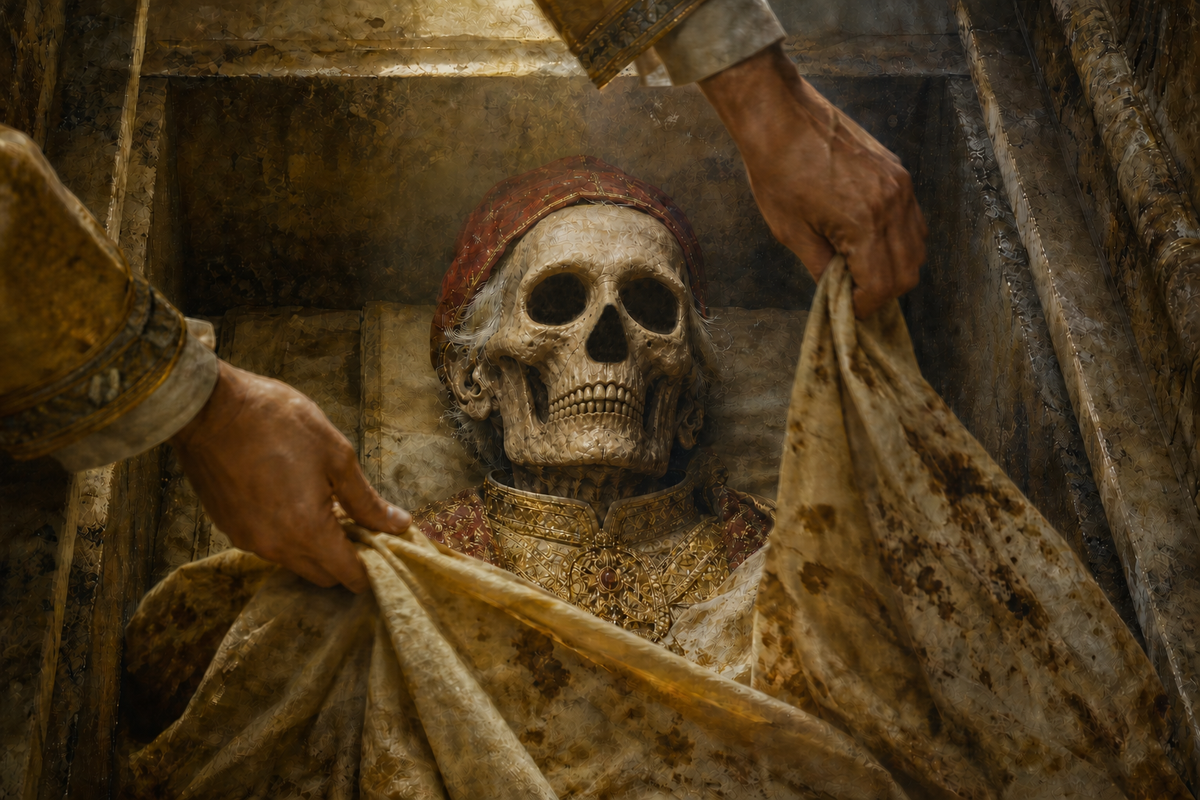
TL;DR: The Cadaver Synod was the posthumous trial of Pope Formosus, held in Rome in January 897. Pope Stephen VI had the corpse — dead for seven months — dressed in papal vestments and seated on a throne. A deacon answered charges on the body's behalf. Formosus was found guilty. Three fingers were cut from his right hand. His body was thrown in the Tiber.
This article contains affiliate links. If you book through these links, Hidden World earns a small commission at no extra cost to you. This supports our research and keeps the guides free.
In January 897, Pope Stephen VI had the corpse of Pope Formosus pulled from its grave, dressed in papal robes, and seated on a throne in the Basilica of St John Lateran. A deacon stood beside the decomposing body to speak on its behalf. Stephen prosecuted the dead man himself. The Cadaver Synod is the best-documented act of posthumous desecration in papal history.
The Man Before the Corpse
Formosus was born in Rome around 816. He was appointed Cardinal Bishop of Porto in 864 by Pope Nicholas I, who then sent him as a papal legate to Bulgaria in 866. The mission was a considerable success. King Boris of Bulgaria was so impressed that he petitioned Rome to make Formosus the archbishop of an autonomous Bulgarian church. The request was denied. The Church viewed the transfer of a bishop from one diocese to another as a violation of canon law — a charge that would resurface, decades later, over a rotting body on a throne.
Formosus served as papal legate to France in 869 and again in 872. He played a central role in the political negotiations that led to the coronation of Charles the Bald as Holy Roman Emperor in 875. But by 876 he had fallen out with Pope John VIII. He was accused of aspiring to the papacy, abandoning his diocese, and conspiring against the papal court. He fled Rome. John VIII excommunicated him.
The excommunication was lifted in 878, on the condition that Formosus remain in exile and never again exercise priestly functions. Pope Marinus I restored him to the diocese of Porto in 883. In 891, Formosus was elected pope. He was approximately seventy-five years old.
Five Years, Two Emperors, and a Stroke
Formosus inherited a papacy trapped between rival factions of the collapsing Carolingian empire. He crowned Guy III of Spoleto and Guy's son Lambert as co-emperors in 892 — almost certainly under duress. Within months, Formosus turned against the arrangement. He sent envoys north to Arnulf of Carinthia, King of the East Franks, asking Arnulf to march on Rome and remove the Spoletan hold on the papal court.
Arnulf crossed the Alps in early 896. Formosus crowned him Holy Roman Emperor on 22 February 896 in St Peter's Basilica. It was the last significant act of his papacy. Arnulf left Rome almost immediately, suffered a stroke on the journey north, and never returned to Italy. Formosus died on 4 April 896. He was approximately eighty years old.
His successor, Boniface VI, lasted fifteen days before dying — most likely of gout. The next pope was Stephen VI.
The Trial
Stephen VI had been consecrated as Bishop of Anagni by Formosus himself. The precise reasons for his hostility toward his predecessor are still debated. The traditional explanation holds that the Spoletan faction — Lambert and his mother Angiltrude — pressured Stephen into the trial after reclaiming control of Rome following Arnulf's departure. The historian William S. Monroe, in his doctoral dissertation at Columbia University (The Trials of Pope Formosus, 2021), disputes this, arguing that no reliable contemporary source connects Lambert directly to the order. Monroe contends Stephen may have acted out of political desperation, attempting to consolidate his own legitimacy by retroactively destroying his predecessor's.
Whatever the cause, the sequence of events is not in serious dispute.
In January 897, Stephen ordered the tomb of Formosus opened. The body — dead for approximately seven months — was removed from St Peter's Basilica, dressed in full pontifical vestments, and transported to the Basilica of St John Lateran. There, it was propped upright on the papal throne.
A young deacon was assigned to stand beside the corpse and respond to the charges on its behalf. The charges were three: that Formosus had committed perjury, that he had illegally transferred from the diocese of Porto to the diocese of Rome (a violation of canon law), and that he had coveted and seized the papacy while still technically bishop of another see.
Stephen prosecuted the case himself. The tenth-century historian Liudprand of Cremona, writing in his Antapodosis (c. 960), records that Stephen addressed the corpse directly, demanding to know why Formosus had left Porto to claim the papal throne. The Annales Alamannici, a near-contemporary Frankish chronicle, describes the scene more tersely: the corpse was placed on the throne, the deacon answered for it, it was stripped of its vestments, and blood flowed from its mouth.
The verdict was guilty on all charges.
What They Did to the Body
The punishment was carried out immediately. The papal vestments were stripped from the corpse and replaced with the clothes of a layman. Three fingers were cut from the right hand — the fingers Formosus had used in life to perform consecrations and blessings. By removing them, Stephen was symbolically — and, in the logic of ninth-century canon law, literally — nullifying every ordination, every consecration, and every blessing Formosus had ever performed.
The consequences were not theoretical. Every priest Formosus had ordained was no longer a priest. Every bishop he had consecrated was no longer a bishop. Every sacrament performed by those men was, in the eyes of the Church, void.
The body was initially buried in a cemetery reserved for foreigners and pilgrims. Then it was dug up again, weighted, and thrown into the Tiber.
The Earthquake
Multiple later sources report that an earthquake struck the Basilica of St John Lateran during the trial, damaging part of the building. The chronicler Auxilius of Naples, writing in the early tenth century, interpreted the earthquake as a sign of divine condemnation. Later medieval accounts expanded this into an image of the stones themselves crying out against the sacrilege.
Whether the earthquake occurred during the trial, shortly before it, or shortly after remains uncertain. It is not mentioned in the Annales Alamannici. It may be a later embellishment designed to frame the Cadaver Synod as an act condemned by God. What is certain is that the Lateran basilica did sustain structural damage around this period — the collapse has been archaeologically confirmed.
The Aftermath
The reaction was swift. The Roman public turned against Stephen VI. By the summer of 897 — less than six months after the trial — Stephen was deposed, stripped of his papal insignia, and thrown into prison. He was strangled in his cell in July or August of the same year.
Formosus's body was recovered from the Tiber. According to multiple sources, it was found by a fisherman or by monks who had been watching the river. Pope Theodore II, who reigned for only twenty days in December 897, convened a synod that annulled the Cadaver Synod's verdict, reinstated Formosus's ordinations, and ordered the body reburied with full honours in St Peter's Basilica.
In 898, Pope John IX convened two further synods — one in Rome and one in Ravenna — that formally condemned the Cadaver Synod, excommunicated seven cardinals who had participated, and banned all future posthumous trials. The acts of the Cadaver Synod were ordered destroyed.
That ban did not hold. Pope Sergius III, who took office in 904 and who had sat as a co-judge at the original trial, reversed everything. He reaffirmed the guilty verdict against Formosus and had a laudatory epitaph inscribed on Stephen VI's tomb. The back-and-forth over Formosus's legacy continued for years. By some accounts, the body was exhumed yet again, retried, and beheaded.
The Catholic Church today recognises none of the Cadaver Synod's findings. Formosus is listed as a legitimate pope in the official papal chronology.
Key Facts
- The Cadaver Synod took place in January 897 in the Basilica of St John Lateran in Rome.
- Pope Stephen VI ordered the body of Pope Formosus — dead for approximately seven months — exhumed, dressed in papal vestments, and propped on a throne for trial.
- A deacon was assigned to speak for the corpse; Formosus was found guilty of perjury, violating canon law, and illegally seizing the papacy.
- Three fingers were cut from the corpse's right hand — the fingers used for blessings and consecrations.
- The body was thrown in the Tiber and later recovered.
- Stephen VI was deposed, imprisoned, and strangled within months of the trial.
- Pope Theodore II annulled the Cadaver Synod in December 897; Pope John IX banned posthumous trials at the Synod of Ravenna in 898.
People Also Ask
What was the Cadaver Synod?
The Cadaver Synod (Synodus Horrenda) was the posthumous ecclesiastical trial of Pope Formosus, conducted in January 897 at the Basilica of St John Lateran in Rome. Pope Stephen VI ordered Formosus's corpse exhumed, dressed in papal vestments, and seated on a throne. A deacon answered charges on the corpse's behalf. The body was found guilty, mutilated, and thrown in the Tiber.
Why did Pope Stephen VI put a dead pope on trial?
The most widely cited explanation is political. Formosus had crowned Arnulf of Carinthia as Holy Roman Emperor in 896, betraying the Spoletan faction that controlled Rome. Stephen VI — possibly under pressure from that faction, possibly acting to secure his own legitimacy — used the trial to retroactively annul Formosus's papacy and every appointment he had made. The historian William S. Monroe argues Stephen was acting independently, not on Spoletan orders.
What happened to the body of Pope Formosus after the trial?
Three fingers were cut from the right hand. The body was stripped of papal vestments, dressed as a layman, and initially buried in a cemetery for foreigners. It was then dug up again and thrown into the Tiber. The corpse was recovered — by a fisherman or by monks — and eventually reburied with full honours in St Peter's Basilica under Pope Theodore II in December 897.
What happened to Pope Stephen VI after the Cadaver Synod?
Stephen VI was deposed, imprisoned, and strangled in his cell in the summer of 897 — less than six months after the trial. The Roman public had turned against him, and a political uprising led to his arrest.
Did the Catholic Church reverse the Cadaver Synod?
Yes. Pope Theodore II annulled the verdict in December 897. Pope John IX held synods in Rome and Ravenna in 898 that condemned the trial, excommunicated seven participating cardinals, and banned posthumous trials. Pope Sergius III later reversed these reversals in 904, but the Church's current position recognises Formosus as a legitimate pope.
Where did the Cadaver Synod take place?
The trial was held in the Basilica of St John Lateran (Basilica di San Giovanni in Laterano), the official cathedral of the Bishop of Rome. The basilica still stands on the Piazza di San Giovanni in Laterano in Rome and is open to visitors. There is no marker or plaque commemorating the Cadaver Synod inside. It is roughly two kilometres from the site where Julius Caesar was killed — Rome layers its violence quietly.
What does Synodus Horrenda mean?
Synodus Horrenda is Latin, typically translated as "the dreadful synod" or "the horrible synod." The term was applied by later chroniclers, not by the participants themselves. The word horrenda in classical Latin carries the sense of something that causes physical revulsion — closer to "a thing that makes you shudder" than simply "bad."
The Building Still Stands
The Basilica of St John Lateran is the oldest of the four papal basilicas in Rome. It predates St Peter's. It is, technically, the cathedral of Rome — the seat of the Bishop of Rome, which is the pope's primary ecclesiastical title. Every pope from the fourth century to the fourteenth century lived in the Lateran Palace beside it.
The building where Stephen screamed accusations at a seven-month-old corpse is the same building where millions of visitors walk through every year. There is no sign on the wall. No plaque in the nave. No mention on the audio guide. The Cadaver Synod happened in the most important church in Christendom, and the Church would prefer you did not think about it while you are standing inside. Guided tours of the basilica and medieval cloister are available through Viator.
Published: June 2026 · Written by the Hidden World research team · hiddenworld.io
More stories like this at hiddenworld.io