What Is Under the Square in Front of Notre-Dame de Paris?
Beneath the parvis of Notre-Dame lies a 200-metre archaeological crypt containing the layered ruins of three separate cities — Roman, medieval, and 19th-century Paris — stacked on top of each other. Most visitors above never know it is there.

TL;DR: Beneath the parvis of Notre-Dame de Paris lies the Crypte Archéologique — a 200-metre underground museum containing the layered foundations of Roman Lutetia, the medieval city, and Haussmann-era Paris, all stacked on top of each other. The crypt was discovered in 1965 when construction workers broke through into a sealed Roman-era room during excavations for an underground car park. The site opened to the public in 1980. On a busy day, perhaps forty people visit. The square above holds thousands.
This article contains affiliate links. If you purchase through these links, Hidden World earns a small commission at no extra cost to you. This supports our research and keeps the guides free.
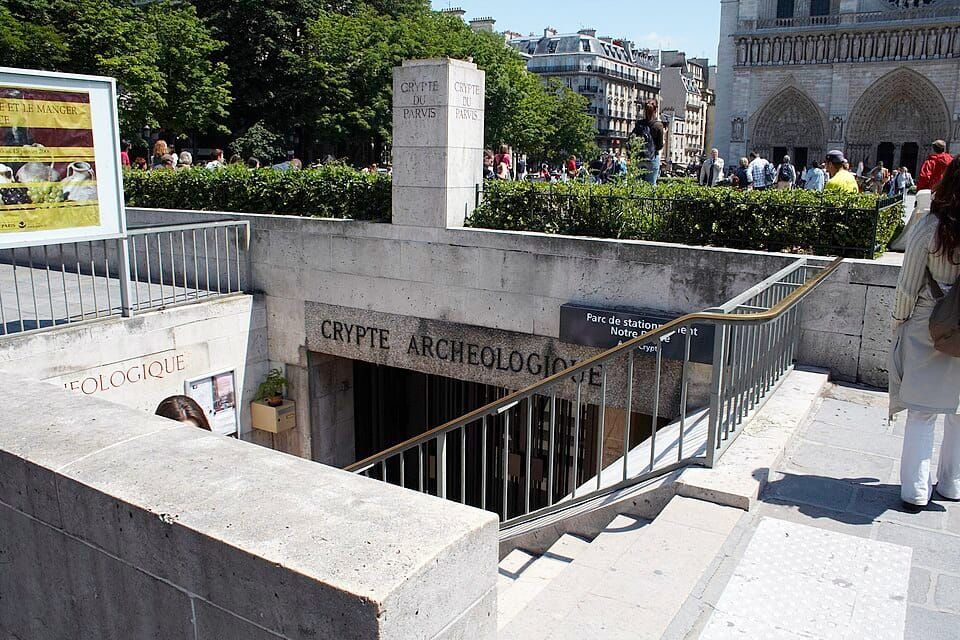
Stand in the square in front of Notre-Dame de Paris and you are standing on top of a ghost. Beneath the paving stones, sealed under reinforced glass and reached by a staircase most people walk straight past, lies the Crypte Archéologique de l'Île de la Cité — the buried skeleton of three separate cities, Roman, medieval, and 19th-century, layered on top of each other like geological strata of construction and demolition. The crypt is 200 metres long. It is the largest underground archaeological site in Europe. Most visitors to Notre-Dame have no idea it exists.
How Was the Crypte Archéologique Discovered?
In 1965, construction workers began excavating beneath the parvis of Notre-Dame to build an underground car park. They broke through into a Roman-era room that had been sealed for approximately 1,700 years. The discovery halted the construction project for three years.
The excavations continued from 1965 to 1972, directed by archaeologists who realised they were standing inside the layered foundations of the entire island's history. What the workers had punctured was not a single structure but a compressed vertical record of two millennia of continuous occupation — Roman public baths, medieval house cellars, fragments of vanished churches, and the rubble of Haussmann's 19th-century demolitions, all superimposed in the same confined space.
The site was formally converted into a museum and opened to the public in 1980. It was later placed under the management of the Musée Carnavalet, the city of Paris's history museum. The crypt measures 118 metres in length and 29 metres in width. In Lorànt Deutsch's Metronome: A History of Paris from the Underground Up, the Île de la Cité station is described as descending nearly fifty feet below the water level of the Seine — a descent into the geological entrails of the city itself.
What Did the Romans Build on the Île de la Cité?
The Romans called this place Lutetia. The name translates roughly as "place near a swamp." Julius Caesar mentioned it in his account of the Gallic Wars — the first written record of the settlement that would become Paris. A Celtic tribe called the Parisii had held the river crossing for approximately three hundred years before Caesar's legions arrived in 52 BC.
In the early 1st century AD, under the emperor Augustus, several small islands in the Seine were joined together to form the single landmass now known as the Île de la Cité. The Romans built on it aggressively. The crypt preserves a section of the ancient river quay — the only surviving fragment of the Roman port — where traders docked along the Seine. Nearby, the remains of a public bath complex from the 3rd century AD are visible, complete with the base structures of heated rooms: a caldarium and tepidarium with underfloor plumbing more sophisticated than anything Paris would possess for the next thousand years.
By the middle of the 3rd century, the island was completely built over. The crypt displays the base of a column from this period, evidence of large, luxurious dwellings that occupied the space. When the first Germanic invasions threatened Lutetia from the mid-3rd to the 5th century, the Île de la Cité was fortified in 308 AD. It became the defensive centre of the city, and the Roman settlement on the left bank was partially abandoned.
How Did Medieval and Modern Paris Bury the Roman City?
Construction of Notre-Dame cathedral began in 1163 under Bishop Maurice de Sully. The medieval city grew outward from the cathedral, and the crypt preserves evidence of this expansion: the foundations of the rue Neuve Notre-Dame, a street created in alignment with the cathedral's central doorway, and the underground levels of medieval houses that once lined it — including cellars belonging to buildings identified by their hanging signs, the Agnus Dei and Saint-Victor.
Two churches once stood north of the rue Neuve Notre-Dame: Saint-Christophe and Sainte-Geneviève des Ardents, the latter demolished in 1748. Their foundations remain visible in the crypt. The Hôtel-Dieu hospital was rebuilt to the south of the cathedral square. Layer upon layer, the medieval city pressed down on the Roman one.
In the 18th century, medieval buildings were demolished to ease traffic and improve sanitation. Then came Haussmann. In the 1860s, Napoleon III's prefect launched his programme of radical urban restructuring. On the Île de la Cité, seventeen churches and an entire labyrinth of medieval lanes were destroyed. The hospice des Enfants-Trouvés and the original Hôtel-Dieu disappeared in 1877. Barracks — now the police headquarters — were built at the far end of the square. The rubble of all this destruction went straight down, burying the Roman and medieval layers even deeper. Andrew Hussey's Paris: The Secret History traces how the archaeologist Théodore Vacquer spent the Haussmann era racing to record Roman remains that were being exposed and then immediately destroyed by the same programme of demolition.
The parvis acquired its current layout by the end of the 19th century. Everything below it was sealed and forgotten. It stayed that way for sixty-five years — until the car park excavation in 1965 broke the seal.
What Can You See Inside the Crypte Archéologique Today?
The crypt presents over 2,000 years of continuous construction in cross-section. Walking the 200-metre route, a visitor passes from Gallo-Roman antiquity through the Middle Ages to the 19th century. The Roman quay, the bath complex, the medieval cellars, the church foundations, and the Haussmann-era remnants are all displayed in situ — exactly where they were found, one period on top of another.
Interactive video screens overlay virtual reconstructions of Roman Lutetia onto the current cityscape, showing what the same ground looked like during the reign of Augustus. Models and information panels trace the sequence of occupations. The exhibition "Dans la Seine," which ran from January 2024 to January 2026, displayed 150 objects recovered from the riverbed by archaeologists, shown alongside the Roman remains.
The crypt is 118 metres long and 29 metres wide. It received approximately 140,000 visitors in 2008 — a fraction of the millions who visit Notre-Dame itself each year. On a typical day, perhaps forty people descend the staircase. The square above holds thousands. The entrance is a small kiosk on the left side of the Place Jean-Paul II, the forecourt in front of the cathedral. Most people walk past it without registering what is below their feet.
Why Does the Crypte Archéologique Matter for Understanding Paris?
The Île de la Cité is where Paris began. The Parisii tribe gave the city its name — their coins have been recovered from the Seine. Caesar conquered them in 52 BC. The Romans built Lutetia on the ruins. The Franks took it from the Romans. The medieval church built Notre-Dame on top of everything. Haussmann demolished the medieval city and buried the rubble on top of that.
The crypt is the only place in Paris where this entire sequence is visible in a single room. It is not a reconstruction. It is the actual stone — Roman walls holding up medieval foundations holding up 19th-century fill holding up the parvis of Notre-Dame. The French Ministry of Culture's archaeological division notes that no Gallic-period fortifications or burn layers have ever been found on the Île de la Cité despite multiple excavations, which has led some archaeologists to propose that the original Celtic settlement may have been located at Nanterre, several kilometres to the northwest. The question of where Paris was actually born remains, in archaeological terms, unresolved.
For anyone interested in the deeper history of how Roman Gaul became France, Barry Cunliffe's Druids: A Very Short Introduction covers the Celtic world that Lutetia emerged from — including why the Parisii burned their own city rather than let Caesar take it, and why the druids' refusal to write anything down meant an entire civilisation's knowledge vanished when the tradition ended.
Key Facts
- The Crypte Archéologique lies directly beneath the parvis of Notre-Dame on the Île de la Cité, 4th arrondissement, Paris.
- Construction workers discovered the Roman-era remains in 1965 during excavation for an underground car park; the project was halted for three years.
- Excavations continued from 1965 to 1972; the crypt opened to the public in 1980.
- The crypt is 118 metres long and 29 metres wide — the largest underground archaeological site in Europe.
- Visible remains span from the 1st century AD (Gallo-Roman Lutetia) through the 19th century (Haussmann-era demolitions).
- The Île de la Cité was fortified in 308 AD as a defensive position against Germanic invasions, and the Roman left-bank settlement was partially abandoned.
People Also Ask
What is the Crypte Archéologique du Parvis Notre-Dame?
The Crypte Archéologique is an underground archaeological museum located directly beneath the square in front of Notre-Dame cathedral on the Île de la Cité. It contains the preserved foundations and ruins of buildings spanning from Gallo-Roman Lutetia (1st century AD) through the medieval and Haussmann eras. The site was discovered during construction work in 1965 and opened as a museum in 1980.
How was the crypt under Notre-Dame discovered in 1965?
Workers excavating the parvis of Notre-Dame to build an underground car park broke through into a sealed Roman-era structure. Archaeologists were called in, and the car park project was suspended while excavations continued from 1965 to 1972. The scale of the discovery — ruins from multiple centuries stacked vertically — led the city to convert the site into a permanent museum rather than proceed with the original construction.
What does Roman Lutetia under Notre-Dame look like?
The Roman remains in the crypt include a section of the ancient river quay (the only surviving fragment of the Roman port), the base structures of a 3rd-century public bath complex with heated rooms, a column base from a large Roman dwelling, and portions of the 4th-century defensive rampart. The remains are displayed in situ, exactly as they were found, beneath reinforced glass walkways.
How did medieval Paris build over Roman foundations?
After the fall of Roman rule, the Île de la Cité became the centre of medieval Paris. Construction of Notre-Dame began in 1163, and the surrounding neighbourhood grew over the Roman layers. Medieval houses, churches, and the Hôtel-Dieu hospital were built directly on top of the earlier structures. Their cellars and foundations are visible in the crypt, sitting above the Roman walls and bath complexes beneath them.
When is the Crypte Archéologique open and how do I visit?
The crypt is normally open Tuesday to Sunday, 10:00 to 18:00. Admission is €9 and is included in the Paris Museum Pass. The entrance is a small kiosk on the left side of the Place Jean-Paul II, the forecourt in front of Notre-Dame cathedral. No reservation is required. Note: the crypt is scheduled to close for renovations from 29 June to 31 December 2026 — check crypte.paris.fr before visiting.
Is the Crypte Archéologique worth visiting?
The crypt is one of the only places in Paris where 2,000 years of continuous urban construction are visible in a single space. It is rarely crowded, even during peak season, and takes 45 to 60 minutes to walk through. The site pairs well with visits to Notre-Dame (directly above, free entry), Sainte-Chapelle, and the Conciergerie — all within a five-minute walk on the same island.
What other Roman ruins can you see in Paris?
The Arènes de Lutèce in the 5th arrondissement is a partially restored Roman amphitheatre from the 1st century AD that could seat 15,000 to 17,000 people. The Thermes de Cluny, also in the 5th arrondissement, preserves the frigidarium (cold room) of a Roman bath complex with vaults rising to 14.5 metres — among the tallest surviving in the western Roman Empire. Both sites are free or included in museum passes.
The Île de la Cité is the oldest continuously occupied site in Paris. Beneath the parvis, the stone record is still intact — Roman walls supporting medieval foundations supporting Haussmann's rubble supporting the paving stones where eleven million annual visitors to Notre-Dame stand and look up. The staircase going down is on the left side of the square. It has been there since 1980. Almost nobody takes it.
The Hidden Paris guide covers twelve places like this one — the full story is free at hiddenworld.io.
Published: July 2026 · Written by the Hidden World research team · hiddenworld.io