Where Was Julius Caesar Actually Killed in Rome?
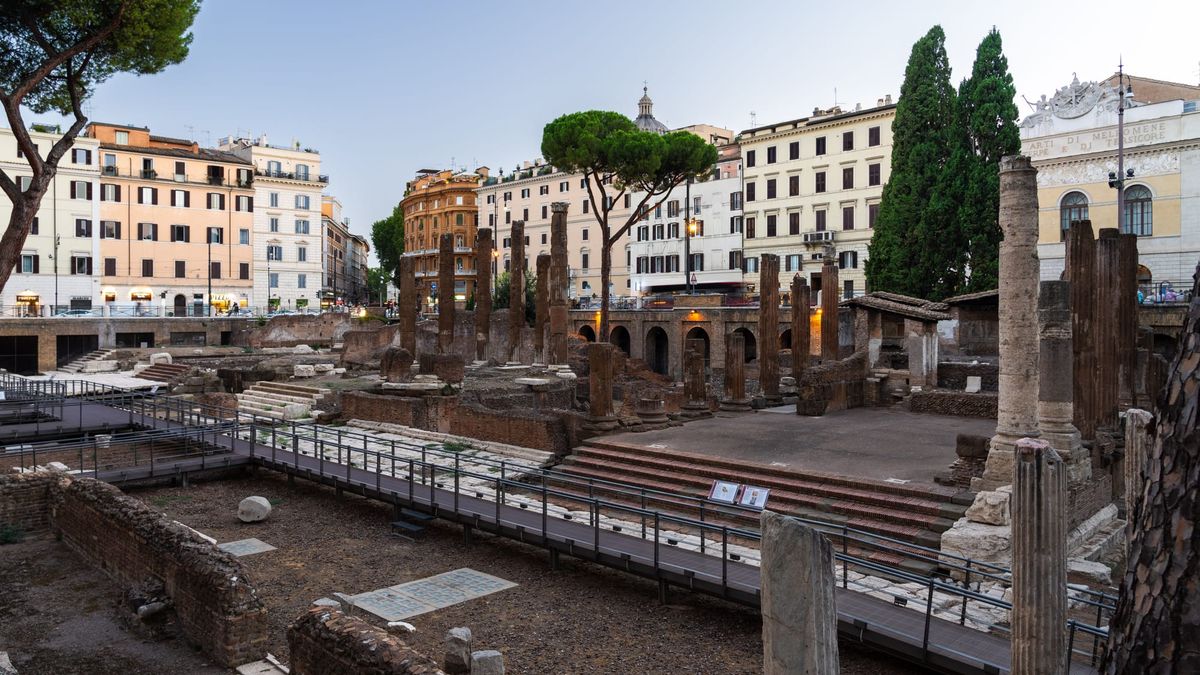
Julius Caesar was killed in the Curia of Pompey, not the Senate House. The site is now Largo di Torre Argentina — buried for centuries, excavated in 1929, and open to visitors since 2023.

Published: May 2026 · Written by the Hidden World research team · hiddenworld.io
This article contains affiliate links. If you book through them, Hidden World earns a small commission at no extra cost to you.
TL;DR: Julius Caesar was killed on 15 March 44 BC in the Curia of Pompey — a temporary meeting hall attached to a theatre complex — not in the Roman Senate House. The site is now Largo di Torre Argentina in central Rome. After the assassination, Augustus sealed the room. After a fire, it was converted into a public latrine. The ruins were buried for centuries, excavated by Mussolini's demolition crews in 1929, and finally opened to visitors with walkways in 2023.
Julius Caesar was killed on 15 March 44 BC in the Curia of Pompey — a meeting hall attached to the Theatre of Pompey — in the area now known as Largo di Torre Argentina in central Rome. He was not killed in the Senate House. Sixty senators stabbed him twenty-three times. He collapsed at the foot of a statue of Pompey. Augustus sealed the room. After a fire, Cassius Dio records it was converted into a public latrine.
Most people get this wrong. The popular image — Caesar falling on the steps of the Senate — is a conflation of Shakespeare with archaeology. The Curia Hostilia, Rome's traditional Senate House, had been destroyed by fire in 52 BC and had not been replaced. Caesar had begun construction of a new Senate House — the Curia Julia — but it was unfinished. The Senate was meeting temporarily in the Curia of Pompey, a hall attached to the rear of Rome's first permanent stone theatre, built by Caesar's political rival Gnaeus Pompeius Magnus in 55 BC.
The distinction matters because the actual building still exists, partially, twenty feet below a modern Roman street. Most visitors to Rome walk directly over it without knowing what is beneath their feet.
Where Was Caesar Killed — and Why Not the Senate House?
The Curia Hostilia — the Senate's traditional meeting place in the Roman Forum — had been destroyed by fire in 52 BC during riots following the murder of the populist politician Publius Clodius Pulcher. Caesar had begun construction of a replacement — the Curia Julia — but the new building was unfinished at the time of his death. In the interim, Senate sessions rotated between several temporary venues.
On the Ides of March, the Senate convened in the Curia of Pompey. This was not a purpose-built political chamber. It was a meeting room attached to the portico behind the Theatre of Pompey, a complex that included a colonnaded garden, a temple, and the theatre itself — a structure large enough to seat between 17,500 and 20,000 spectators.
The Theatre of Pompey: Rome's First Permanent Stone Theatre
The Theatre of Pompey was completed in 55 BC. Pompey had circumvented Roman laws prohibiting permanent theatres within the city by incorporating a Temple of Venus Victrix into the top tier of the seating bowl, technically classifying the whole structure as a temple approach. The Senate was not fooled. The theatre opened anyway. The complex included:
A theatre seating 17,500 to 20,000 spectators — the largest in the Roman world at the time
A colonnaded garden behind the stage building
The Curia of Pompey, a meeting hall attached to the portico, where the Senate convened on 15 March 44 BC
A Temple of Venus Victrix integrated into the top of the seating bowl
Caesar walked into a building raised by his greatest rival, stood on a floor of construction dust, and was surrounded by sixty men who had planned his death. The murder took less than ten minutes. As he collapsed, his body came to rest against the base of a statue of Pompey himself.
What Happened to Caesar's Body After the Assassination?
After the assassins fled to the Capitoline Hill, the body lay on the floor for hours. Three slaves eventually carried it home in a litter, one arm swinging loose. No senator returned for it. No official collected it. The most powerful man in the Roman world was carried home by household staff.
How Augustus Sealed the Murder Scene
Augustus, Caesar's heir, later had the murder room walled up and declared it a place of ill omen. The room was sealed — made inaccessible by deliberate construction. Nobody was to enter it again. The ancient accounts of the sealing and its aftermath are compiled in Cassius Dio's Roman History, hosted by the University of Chicago's LacusCurtius project.
Then fire destroyed the sealed structure. What happened next is recorded by Cassius Dio: the site was converted into a latrine. Rome's most consequential murder scene was officially designated a public toilet.
How Was the Assassination Site Rediscovered?
The ruins of the Theatre of Pompey and the surrounding structures were buried under approximately twenty feet of accumulated city over the following centuries. Rome builds on top of itself. The layers compress but do not disappear.
Mussolini's 1929 Excavation
In 1929, Mussolini's urban demolition programme — which was clearing medieval buildings across central Rome to expose ancient monuments — broke through to the remains of four Republican-era temples at what is now Largo di Torre Argentina. The Soprintendenza Capitolina ai Beni Culturali oversees the site today. It was excavated and preserved, but left as a sunken pit visible only from the street above. For the next ninety years, nobody could descend into it.
The Cat Colony and the 2023 Opening
Cats colonized the ruins. A feral cat colony established itself in the archaeological pit and became one of Rome's minor tourist attractions in its own right. The Torre Argentina Cat Sanctuary has operated in the ruins since 1993, caring for the colony among the remains of the four temples.
In 2023, walkways finally opened that allow visitors to descend into the archaeological area for the first time. The room where Caesar died still sits partly beneath Via di Torre Argentina and the Teatro Argentina. You cannot stand in the exact spot. But you can stand five meters from it while the 64 bus passes overhead.
[Link to related article: The Street That Remembers a Vanished Theatre — Via di Grotta Pinta]
The curved facade of apartments along nearby Via di Grotta Pinta traces the exact circumference of Pompey's auditorium — the same building complex where Caesar was killed. Several restaurants in the area have original Roman masonry in their basements. Restaurant Pancrazio at Piazza del Biscione 92 has ancient walls visible during dining hours.
What Can You See at Largo di Torre Argentina Today?
As of 2026, tickets are required to enter the archaeological area at Largo di Torre Argentina. The site is open daily. Guided tours of the Area Sacra — including the Curia of Pompey and the four Republican temples — can be booked through Viator. The walkways built in 2023 bring visitors to the level of Temples A, B, C, and D, which date from the 4th to 2nd centuries BC.
The Curia of Pompey itself is not fully visible. It sits partly beneath the modern street and the Teatro Argentina theatre building. What visitors see at Largo di Torre Argentina are the temples and associated structures from the same period, in the same archaeological complex. The proximity is the point: you are standing in the footprint of the Theatre of Pompey complex, meters from where the assassination occurred.
The full story of Largo di Torre Argentina — including the precise relationship between the four temples, the Curia of Pompey, and the Theatre complex — is told in the Hidden Rome guide, available at hiddenworld.io.
The site is free to view from the street above. The cat sanctuary is accessible without a ticket and accepts donations.
Why Does This Correction Matter?
The popular image of Caesar dying on the Senate steps comes from paintings and film adaptations, most of them influenced by Shakespeare rather than by the ancient sources. Plutarch, Suetonius, and Cassius Dio all place the assassination in the Curia of Pompey. None describe it happening in the Forum or on the steps of the Senate House.
The Curia Julia — the Senate House that still stands in the Roman Forum today — was not built until after Caesar's death. Augustus completed it. The building tourists photograph as the Senate House did not exist when Caesar was killed. The actual murder happened in a different building entirely, roughly a kilometer to the west, beneath what is now a busy road junction with a bus route running over it.
The gap between the popular story and the documented history is wider at Largo di Torre Argentina than almost anywhere else in Rome. Most visitors to the city walk past the site without realizing what lies beneath the street. The ruins were inaccessible for ninety years. The walkways are new. The cats are older than the public access.
The ancient sources are clear on every detail: the building, the statue, the number of wounds, the time it took, the fate of the body, and what the room became afterward. The correction is not speculative. It is Cassius Dio, Plutarch, and Suetonius versus a play written in 1599.
For visitors to Rome who want the documented version — the primary-source trail from Plutarch to the 1929 excavation to the 2023 walkways — the Hidden Rome guide covers all twelve stories.
Frequently Asked Questions
Where exactly was Julius Caesar assassinated?
Caesar was assassinated in the Curia of Pompey, a meeting hall attached to the Theatre of Pompey. The site is now beneath Largo di Torre Argentina and Via di Torre Argentina in central Rome, in the Centro Storico district. He was not killed in the Roman Senate House (Curia Hostilia), which had been destroyed by fire in 52 BC.
What was the Curia of Pompey?
The Curia of Pompey was a meeting room within the portico of the Theatre of Pompey, Rome's first permanent stone theatre, built by Gnaeus Pompeius Magnus and completed in 55 BC. The Senate used it as a temporary meeting venue after the Curia Hostilia was destroyed by fire in 52 BC. It was part of a larger complex that included a colonnaded garden and a temple to Venus Victrix.
How did Augustus seal off Caesar's murder scene?
After the assassination, Augustus — Caesar's heir — had the murder room walled up and declared it a place of ill omen. The room was made physically inaccessible through deliberate construction.
Why did Rome convert Caesar's death site into a latrine?
After a fire destroyed the sealed structure, the Roman historian Cassius Dio records that the site was converted into a public latrine.
Can you visit Largo di Torre Argentina in 2026?
Yes. The archaeological area at Largo di Torre Argentina is open daily. Walkways opened in 2023 that allow visitors to descend into the ruins for the first time in ninety years. As of 2026, tickets are required for entry to the archaeological walkways. The site is also visible for free from the street above. The Torre Argentina Cat Sanctuary operates within the ruins.
What is the connection between Largo di Torre Argentina and Via di Grotta Pinta?
Both sites are part of the Theatre of Pompey complex. Largo di Torre Argentina sits over the area near the Curia of Pompey where Caesar was killed. Via di Grotta Pinta, near Campo de' Fiori, follows the curved outline of the theatre's seating bowl — apartments there trace the exact circumference of the ancient auditorium, two thousand years after it was buried.
Is the cat sanctuary at Largo di Torre Argentina still operating?
The Torre Argentina Cat Sanctuary has operated among the ruins since 1993. It cares for a feral cat colony that colonized the archaeological pit during the decades when the site was inaccessible to humans. The sanctuary is accessible without an archaeological area ticket and accepts donations.
Hidden World is an independent research project documenting the stories that standard travel guides leave out. The Hidden Rome guide covers 12 documented stories across the city, each built from primary sources. Available at hiddenworld.io.